Showing posts with label Captain Lou Albano. Show all posts

Thursday, November 18, 2021

The Territory Photo Albums--Pittsburgh 1969

Since its inception this blog has always had something of a Pittsburgh flavor. After all, I've made my home in Pittsburgh for my entire life. But "The Burgh" is somewhat underappreciated for its rich wrestling history. Of course we claim Bruno Sammartino as our own, but it's sometimes forgotten on a larger scale just how many big names of wrestling's past spent their time here. Bruno needed challengers, allies and plenty of other talent to fill out cards at the Civic Arena and on the immensely popular "Studio Wrestling" program.

The Pittsburgh wrestling office, like many territories, periodically released photo album publications to remind you of the great wrestling roster in your area. There were five total, all released under the banner of "Tri-State Wrestling." I've featured them on this blog before, with the 1967 edition being a previous entry in the "Territory Photo Albums" series, but today we're looking at the final one that was produced in 1969. 

While the first editon, published in 1963, has Buddy Rogers featured most prominently, Bruno has clearly become the star in his six years as champion. In fact this edition features more Bruno than anyone else. There's no doubt about it, though, he was the man. While most associate New York as his top town, you would be hard-pressed to find someone who grew up in Pittsburgh in the '60s who didn't know The Living Legend. The Italian Superman. The Champ. He was, and still is, a Pittsburgh sports icon revered alongside the likes of Roberto Clemente. 

Our cover features Bruno sharing the spotlight with Tony "Battman" Marino who we just recently lost. Marino is showing off his famous physique without the costume of The Caped Crusader covering it up. With the Batman television series being off of the air for over a year at this point, the gimmick was about to come to an end as well. Mr. Marino was a class act and is much missed. When I had this particular album signed, he even brought the original "Battman" cowl. Did I mention that the gentleman, well into his '80s at that point, had a patch of hair, on his otherwise bald head, shaved into the Batman logo? 

Inside we get Bruno right off the bat! It's actually the entire Sammartino clan. Carol, David and the twins. Despite what we know about Bruno and David's relationship later on, it's nice to see some family time shown here. This album also includes several pages dedicated to "The Bruno Sammartino Course Of Body Building." This was actually also released as its own publication around the same time as well and I would imagine that it set many a Pittsburgh youth off on the right foot as far as training is concerned. I won't go on a tangent, but there aren't any true role models left in sports today. Bruno was the role model in every sense of the term.

As mentioned above we get great glimpses of so many legends who either starred in the Pittsburgh area or at least passed through. Domenic DeNucci, Ivan Koloff, Lou Albano and Tony Altomare, Waldo Von Erich, Gorilla Monsoon and George "The Animal" Steele. We also have the Pittsburgh mainstays like Bobby "Hurricane" Hunt, Jumpin' Johnny DeFazio and Frank Holtz. The latter may actually be the final living Pittsburgh wrestling star of this era following the recent deaths of DeFazio, Marino and DeNucci.

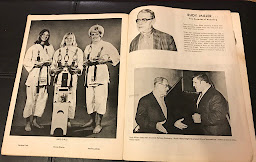
The Tri-State albums always featured bits on non-wrestlers, too, such as Pittsburgh broadcasting legend Bill "Chilly Billy" Cardille who was our voice of wrestling, promoters (including Vincent J. McMahon in one of the early books) and the man credited with discovering Bruno, Rudy Miller. This last installment also features a full page photo featuring three young women labeled "Judo Girls." Darlene Kalb, Donna Waxter and Jordie Ludwig were local judo champions who performed exhibitions during cards at the Civic Arena. I have no idea if the three are still with us, but adding their autographs to the book would certainly be fun as would hearing their stories from the era. 

While we always hear about WWF Magazine, pay-per-view event programs and other similar publications, very little is ever written about these great photo albums. I'm both thrilled and honored to document them for posterity. For more photos of this edition, including more of the autographs that I've filled this one with, follow us on Instagram @jws_wrestling_memorabilia. 

Thursday, October 18, 2018

Wrestling MarketWatch: Magazine Mayhem

Have there really been over thirty editions of our MarketWatch feature over the years? Sure, I just appropriated the title from CBS (my apologies to the "Eye"), but it's always a very fun feature to research and write. While I always champion the fact that collecting should be fun over profit, it is always a blast to see how much, or how little, certain items are currently selling for. It's the only way to have any sort of collectible "price guide" in this day and age. 

Seeing as that they increase and decrease in price perhaps more than any other form of wrestling memorabilia, we're once again looking at magazines. There are many wrestling magazine collectors out there, and for this edition we'll look at a variety of issues from various time periods that have recently seen movement on the market. As always, prices listed are for non-autographed versions.


*Where better to begin than 52 years ago this month? Batmania had swept the country thanks to the magic that was being created by Adam West and company on television every Wednesday and Thursday evening. Wrestling capitalized on the craze, though it was most prominent in Pittsburgh where strongman Tony Marino became "The Battman." Though he played the character for several years (and has the hair on the back of his head shaved into the Bat Signal to this day), his tag team partner dressed as Robin was short-lived. Both were captured in full costume on the October 1966 issue of Wrestling Revue magazine. While Batkids of the day probably readily scooped the magazine up from newsstands, it's a less common issue nowadays and recently sold for $31.


*Around 25 years later another colorful character would capture America's interest, that being Bart Man aka Bart Simpson. Bret "The Hitman" Hart made a cameo on The Simpsons right around what many consider to be the best era of the long-running cartoon. This appearance was immortalized on the cover of the May 1997 issue of WWE Magazine. Bret and Bart recently sold for $50 which is unusual for this particular edition.


*Going back to the late 1970's we see the fourth issue of the short lived Wrestling Action Magazine. The first in-house WWWF publication, this magazine has widely been featured here on the blog over the years, and thanks to editor Les Thatcher we've been able to chronicle the history of the highly collectible run. This issue features the war of the tag teams that was going on at the time pitting The Valiant Brothers and manager Captain Lou Albano against Larry Zbyszko and Tony Garea. The issue recently sold for $24.50 which is actually trending low for this magazine.


*Another titled to come from wrestling renaissance man Les Thatcher was the Mid-Atlantic Wrestling Magazine. One of my favorite covers in a run where it's hard to choose just one is from Issue Vol. 4 No. 5 featuring "Number One" Paul Jones and The Masked Superstar. If there were ever two stars who embodied wrestling in the Carolinas for Jim Crockett Promotions, it's these two gentlemen. The issue recently sold for $51.


*Finally we head back north in August/September 1984 with the World Wrestling Federation. "Rock N Wrestling" was at full steam and in the center of the mayhem were Rowdy Roddy Piper, Captain Lou Albano, and Cyndi Lauper. The three took the cover shot here, obviously on the set of Piper's Pit. As with many of the early WWF Magazines, secondary market value has rarely waned. This classic recently sold for $49.

From cartoon characters to pop singers to wrestling versions of Caped Crusaders, these issues embody the fun of collecting wrestling magazines from the past. What do you have socked away in "Mom's attic?" There could be great reading material up there...and a lot of value in it.

Thursday, July 26, 2018

Wrestling In Other Venues

As big of a part of pop culture as professional wrestling is, it's always fun to see the business outside of the squared circle. While wrestlers can hold their own with icons and celebrities from across the spectrum, it's interesting to see how they interact. Sometimes it's the wrestlers themselves "visiting" in other forms of entertainment. At other times celebrities from outside of the ring will try their hand. Still, in other examples, various genres attempt to incorporate wrestling into their own brand, often with mixed results.

Wrestlers crossing over into non-wrestling television shows has been a staple since the '50s! It was then that Lou Albano "wrestled" the legendary Jackie Gleason in a sketch on the comedian's popular program. Three decades later, as Gleason and "The Honeymooners" were seeing a resurgence, The Captain appeared in an issue of a comic based around the beloved sitcom. In the story Albano is a relative of Ralph Kramden's neighbor Mrs. Manicotti. This, of course, leads the blustery bus driver into the wrestling ring.

Many wrestlers appeared on shows of all types, comedy, action, and drama alike. Hulk Hogan made many guest appearances during the '80s boom period as did Jesse "The Body" Ventura, Rowdy Roddy Piper, King Kong Bundy, and Hacksaw Jim Duggan to name a few. Andre the Giant appeared famously as Bigfoot on an episode of The Six Million Dollar Man. His appearance even spawned a magazine cover and an action figure! Later on, Andre would provide a giant challenge for The Greatest American Hero before landing his most famous role as Fezzig in the film The Princess Bride.

It was not unusual for shows to have wrestling-themed episodes as well. Family Matters, Laverne & Shirley, The Munsters, Boy Meets World, and That '70s Show are ventured into the squared circle, but my favorite has to be the episode of Mama's Family entitled "Mama Mania." GLOW's own Queen Kong and Mt. Fiji guest star as "The Masked Mabels," a corpulent female tag team who end up battling Mama and her daughter-in-law Naomi. The episode captures everything fun about the wrestling boom of the period.

In the '90s, Bret "The Hitman" Hart famously guest starred on The Simpsons. While his appearance on the animated hit was brief, it was memorable. Several years ago when toy company NECA unveiled a line of action figures based on famous guest stars who showed up in Springfield, "The Hitman" was one of the highlights of the collection.

But The Simpsons aren't the only cartoon characters who have encountered wrestlers. While I don't believe that the Teenage Mutant Ninja Turtles ever tangled with wrestling in their cartoon or comic book, the action figures are a different story. There have been figures of the Turtles dressed as WWE favorites over the past few years, but the first TMNT-wrestling hybrid figure debuted in the original line by Playmates Toys. "Shell Slammin' Mike" takes the orange-masked Michaelangelo and transforms him into a caped competitor complete with belt and pet snake.

Last but not least, we look at a man...err...bear who is a champion of children, and adults, everywhere. He may not be "The People's Champion" by name, but he certainly is in our hearts. Is there anyone who doesn't love this guy? Yes, he's the "Hundred Acre Wrestling Federation Champion" according to his belt, and I would imagine he rumblies...err...rumbles over the competition. Who else could it be?


Oh bother!

Thursday, March 8, 2018

The WWE Hall of Fame: The Banquet Years

Sure, it's always been and always will be a subject of contention and controversy, but take it just a little less seriously and it's just plain fun. Like it or not, the WWE Hall of Fame is what the mainstream world will always recognize as the wrestling Hall of Fame. It's simply how it is. Aside from having the WWE banner, the broadcasts are award show-quality as far as production and now attract arenas full of fans. It's hard to believe now, twenty-five years after the creation of the Hall of Fame, but it wasn't always that way.

The first induction that began the Hall of Fame, Andre the Giant in 1993, was a mere announcement on WWF television. The following three years saw small ceremonies with inductions and speeches. These events were actually not much more than dinners held in hotel banquet facilities. The 1995 and 1996 ceremonies were held in conjunction with King of the Ring and Survivor Series in those years respectively.

Many of the all-time great WWE stars took their rightful places in the Hall of Fame at those early events including Buddy Rogers, Chief Jay Strongbow, Freddie Blassie, Bobo Brazil, Gorilla Monsoon, Arnold Skaaland, James Dudley, George "The Animal" Steele, Ernie Ladd, Ivan Putski, The Fabulous Moolah, Pedro Morales, The Grand Wizard, Antonino Rocca, Captain Lou Albano, Killer Kowalski, Johnny Rodz, Vincent J. McMahon, Jimmy "Superfly" Snuka, Pat Patterson, Baron Mikel Scicluna, and the Valiant Brothers.

While it's nice that many of these now-deceased stars were able to enjoy their special night, their longtime fans can only wonder what the inductions of legends like Monsoon or Albano may have been like in the current Hall of Fame format. On the other hand, some of these early stars may have preferred the more intimate atmosphere that these ceremonies held, where fan attendance seemed to be more of an exception than a rule. No ridiculous chants at these banquets, for sure.

Though often unseen, these banquets yielded three individual Hall of Fame programs. Unlike the modern WWE Hall of Fame programs, these were small, four-page affairs printed on heavy paper stock reminiscent of a school concert or wedding program. Seeing as that attendance was greatly limited at these events, these programs do not become available very often. One in my own collection even has a small food stain. Could this have dropped from the fork of a Gorilla? Will you stop?

WWE Network does feature abridged versions of these events. While we may never see the full ceremonies officially released (there may be a "fan cam" version of one, but you didn't hear that from me), at least we have these fun and somewhat rare mementos of the nights where Rogers, Superfly, Blassie, and Patterson, among others, were finally and fully recognized by the company that they largely helped to build.

Thursday, May 19, 2016

WWWF Wrestling Action #4

For the fourth issue of WWWF Wrestling Action, tag teams take center stage. The Tag Team Championship struggle between The Valiant Brothers (with manager Captain Lou Albano) and the fan favorite team of Larry Zbyszko and Tony Garea is artistically depicted. The white and yellow "burst" behind the wrestlers really makes this cover pop, as does the large tag team belt that corrals the teams. I can still recall the joy on Albano's face when he was signing this issue and holding it up for other wrestlers seated nearby to see. In addition to the featured stars, I had referee Dick Woehrle sign the cover and Greg Valentine autograph an interior shot.

Starting out, we learn that the previous issue had completely sold out. Back issues of #1 and #2 were still available at just $2.50 a copy. Again, I will gladly take a dozen of each. Arnold Skaaland gets the "As I See It!" column and the features kick off with a look at a man completely missing from issue #3, Bruno Sammartino. The Living Legend had returned--with his infamous afro. The cover story follows, featuring Zbyszko (grossly misspelled "Zybscko") and Garea on their championship win against the Yukon Lumberjacks and new struggle with Jimmy and Johnny Valiant.

Hisashi Shinma becoming the new World Wide Wrestling Federation president and a bit on Ivan Putski precede a story on The Grand Wizard leading Greg Valentine to the WWWF Championship. Valentine was always one of Bob Backlund's quality challengers. Had Backlund needed to drop the title even briefly at some point during his long-planned run, Valentine would have been a great option as champion, even temporarily.

Next up is a great shot and brief story on WWE Hall of Famer Tatsumi Fujinami. At the time, Fujinami was the WWWF Junior Heavyweight Champion. That title and belt is one of the least remembered championships in the history of the company, largely being contested outside of the United States for the majority of its run. Fans of 1990's Japanese wrestling will remember the belt being given to the winner of the 1994 Super J Cup tournament. The belt even featured into advertising for the event.

In the centerfold we have the "passing of the torch" that the WWWF so desperately wanted at the time, a handshake meeting between Bruno Sammartino and Bob Backlund. While Backlund undoubtedly carved out his own legacy in wrestling and as WWWF Champion, he never filled the boots of "The Living Legend." Looking back in hindsight, both men stand side by side for their contributions to the WWWF and the industry itself just as they do pictured here.

High Chief Peter Maivia makes his return to Wrestling Action, this time
in a very different position than back in the debut issue. Maivia is now a rule breaker managed by Fred Blassie. The High Chief is shown, donning his villainous mustache, squeezing the life out of foes such as Bob Backlund and Chief Jay Strongbow. Heels also dominate the next few pages when Albano and The Valiant Brothers receive their own article touting their recent WWWF return.

It's here that we see photos that were used as inspiration for the drawings on the cover. Zbyszko and Garea's cover poses can also be found as photos inside of this issue. As we've seen by now, virtually all of the cover drawing reference pictures are inside the Wrestling Action issues themselves. Also here is a great shot of Jimmy Valiant perusing the debut issue of Wrestling Action in what looks to be a hotel room. Today's wrestlers return to the hotel to play video games. In the '70s, they retired to their rooms with a copy of Wrestling Action. No alcohol or debauchery whatsoever in either generation.

The fourth issue of Wrestling Action ends with a look at more of the villains of the day. Ernie Ladd gets a two-page spread featuring some great color photos and a vow to finish off Dusty Rhodes, or "The Pillsbury Dough Boy" at he calls him, once and for all. The evil members of the stable of "Hollywood Fashion Plate" Fred Blassie are also shown, including Maivia, Victor Rivera, and Spiros Arion. We finish with a brief look at "Brower Power," the return of classic brawler Dick "The Bulldog" Brower.

You could argue that this issue was the showcase of the heels. Bob Backlund saw his least coverage yet in the Wrestling Action run. Instead the focus was on many of his challengers and their devious plans to wrest the WWWF Championship away from "The All-American Boy." In the fifth and final issue we will see wrestling history right on the cover in several different instances. While Wrestling Action does not escape the 1970's, the issue is going to be all about looking forward to the 1980's. We end the five-part Wrestling Action series next week here on the blog. Don't miss it.

Thursday, May 12, 2016

WWWF Wrestling Action #3

A new World Wide Wrestling Federation Champion helps us celebrate Wrestling Action Vol. 1 No. 3! Bob Backlund, in all his wholesome, straight-laced glory, graces the cover of this issue complete with an American flag background and the nickname "All American." Due to the Yukon Lumberjacks being shown and touted as being the WWWF Tag Team Champions, we can determine that this issue was printed in mid-1978, long after the last. As we'll soon see, the magazine was open and honest about problems with publication.

We open the cover with several announcements. Escalating costs are cited as to why this issue is not the full-color spectacle that the previous installment was. The staff still hopes to be able to return to that format in the future. Another notice indicates that the magazine will not be published bi-monthly, but subscribers will receive their balance. Limited back issues of the first two editions are available for just $2.50 each. Can I take a dozen? The "As I See It!" column this month is penned by Vincent Kennedy McMahon, who is actually referred to as "Vince McMahon Jr." here.

The main features begin with a half-color, half-black & white story on the new champ himself, Bob Backlund. One of the images included was obviously used the cover art reference photo. Following that is a question that many of us are still asking to this day, "What Happened To Victor Rivera?" Back in 1978, the question was why Rivera, a popular Puerto Rican star, had aligned himself with Fred Blassie. Since the late 1980's the question has been just where the man has gone. Rumors of various nefarious activities, time in prison, and even death have surrounded Rivera, but no one seems to have concrete evidence as to exactly where he is.

A bit on Superstar Billy Graham's work out routine is followed by a feature on the good deeds of "The American Dream" Dusty Rhodes. Juvenile Diabetes, Muscular Dystrophy, and the Big Brother program are all listed as some of The Dream's charitable causes. All in all, Dusty is quoted as saying that making us, the fans, happy makes his dream fulfilled. You did just that, Big Dust. You did just that and much, much more...

The next several pages give us black and white photographs of The Dream as well as various ring villains of the day. One great photo depicts Dusty, flanked by a young Vince McMahon Jr. and Howard Finkel, receiving an award from the Big Brother program in New Haven, CT. The Fink has a great comb-over going on. I'm assuming that the gentleman between McMahon and Finkel is from the Big Brother program. Despite similar attire, it is not Fred "Rerun" Berry.

We get even more American Dream goodness in this issue's centerfold. In an absolutely classic pre-match photo, Andre the Giant is pictured with his buddies Rhodes and "The Man of 1,000 Masks" Mil Mascaras. Dusty is wearing his cactus robe which made various program and magazine covers over the years. There's definitely no box under the feet of Andre, and he looks positively massive regardless. As of this writing, only Mascaras remains with us in this life.

Features on Chief Jay Strongbow, Ivan Koloff, Dino Bravo, and Tony Garea fill the remaining pages, but perhaps the coolest article covers the aforementioned Yukon Lumberjacks. Pierre and Eric, managed by Captain Lou Albano, held the WWWF Tag Team Championship for several months in 1978. The rough-and-tumble duo wrestled the titles away from the popular tandem of Bravo and Dominic DeNucci, the latter previously known for his association with Bruno Sammartino and now remembered as the trainer of Mick Foley. Yukon Eric was better known as Scott "Hogg" Irwin. Irwin would later team with his brother Bill as "The Long Riders" in the AWA before tragically passing away from cancer in 1987.

We're now over halfway through the Wrestling Action run. This is the first issue to not feature Bruno Sammartino. The WWWF was looking to a new era with Bob Backlund at the helm. We now know that it would end up being a Helluva run for the "All-American Boy." A different division takes center stage in the next issue, along with five new cover stars. The "wrestling action" of the WWWF continues here next week!

Thursday, December 4, 2014

30 Years of "Those Big, Rubber Wrestlers"

You see might see the description in a badly listed eBay auction or even used during a nostalgic wrestling conversation.  They were the WWF Wrestling Superstars by LJN, but to many, they were "those big, rubber wrestlers."  It would have been very hard to be a wrestling fan and not encounter those "big, rubber" wrestling figures at some point in the past thirty years.  They depicted Hulk Hogan, Rowdy Roddy Piper, The Iron Sheik, Nikolai Volkoff and dozens of other WWF Superstars in a larger-than-life way that has never quite been duplicated.  They've shown up in film, on television, and in print.  They aren't action figures in the traditional sense, yet to not include them in the genre would be blasphemy.  You, your neighbor, your cousin, and your classmates had at least one, and even with paint and rubber wear all of these years later, it's still a relic to be cherished.

The LJN WWF figure line began in 1984.  While it was not the first wrestling figure line (that distinction falls to a series produced by Popy in Japan), it was the first in America, beating out Remco's AWA collection by months.  Some, including a few of the wrestlers themselves, refer to the products as dolls.  There will never be a definitive answer to the old "It's not a doll, it's an action figure" argument, but these replica wrestlers weren't playing dress-up, they were seeing action in and out of the ring.

What I most love about the LJN line was the inclusion of non-wrestler figures.  Sure, it's amazing to be able to have dream matches like Hulk Hogan against Bruno Sammartino and Ricky Steamboat versus Dynamite Kid, but figures of managers, announcers, and referees only add to the depth of play.  It's no wonder that so many loose examples these days have so much paint wear; these wrestlers WRESTLED!

"Twist Em, Turn Em" was one of LJN's selling point catchphrases for the line, and it was true.  While the figures were not articulated, with the exception of a few pointlessly posed examples (Paul Orndorff, Rick Rude) the design of the toys made them extremely playable.  The Hulkster could slam any other figure while Randy Savage was perfectly poised for a patented flying elbow drop.  God-like figures for God-like superstars.

The figures had a pumped-up look which was very lifelike for the wrestlers of the day.  Unlike today when bulging muscles look out of place on wrestling figures, the wrestlers themselves didn't look like the guy down the street.  There was much more individuality, which in turn made many more stars stand out.

Like companies today, LJN wasn't satisfied with just one standard line.  Attempts to branch out were made, but none lasted as long as the 8-inch original figures.  A lower cost line of Bendies were introduced about a year into the life of the license.  Wires inside of these smaller figures helped hold their poses.  Aside from the wrestlers, a ring/cage and two managers were produced, but the line did not sustain.  Prototype pictures of further releases have surfaced since, proving that LJN had high hopes.

In 1987, a half dozen figures were released as Stretch Wrestlers.  These figures were a takeoff on the decades-old Stretch Armstrong figure concept, where a cornstarch mix inside of a pliable "skin" allows the figure to be stretched into all kinds of contortions.  Sadly, the design of all of these kinds of figures does not lend itself to good condition over time.  Many that remain are in poor condition or are too brittle to really even touch.

Thirty years.  While much of the paint and shine of these figures is gone, the memories remain.  I can still recall going into the.long gone but beloved Hills Department Store and seeing the large LJN merchandising footprint in the toy aisles.  Stretch Wrestlers stacked to the ceiling.  Individual figures like Hillbilly Jim, Miss Elizabeth, and Mean Gene Okerlund (or "the farmer," "the girl," and "the announcer" as I naively named them) filling the pegs.  The feeling that this unusual yet compelling sport was at the height of its popularity, and that the characters produced from it were genuine celebrities.  Household names forever immortalized as "those big, rubber wrestlers."

Thursday, August 30, 2012

From The Musty Yellowed Pages--WWF Magazine August/September 1985

This month we've explored the era of the "Rock 'n Wrestling Connection" quite a bit.  From the 1985 Topps WWF cards to the Rock 'n Wrestling cartoon, I think that we've covered the fun and "mania" that surrounded this time period in professional wrestling.  Although the mid-'80s "boom" period for wrestling seems to be universally accepted as stretching from Hulk Hogan's title win to just about early 1988, the Rock 'n Wrestling Connection itself was only about a year long.  The time when Cyndi Lauper seemed to disappear from the WWF, Wendi Richter herself vanished for obvious reasons, and WWF programming stopped appearing on MTV seems to be the cutoff point.  The WWF Magazine cover dated August/September 1985 is probably a good cutoff merchandise-wise, and that is what we're exploring today to top off the month of '80s glory.

Probably due to their own licensing deals, Lauper and Mr. T didn't appear on all that much WWF merchandise.  The cover of WWF Magazine is an exception for both.  Lauper appears here in a picture from the shoot for her "The Goonies 'R' Good Enough" music video along with Rowdy Roddy Piper, Nikolai Volkoff, and The Iron Sheik.  With a bright orange background inserted behind the "fearsome" foursome, you can't miss the cover.  The first actual page (the inside cover is the letters page) starts right off with the WWF marketing machine.  Coliseum Video Presents WWF WrestleMania--The Greatest Wrestling Event Of All Time!  $39.95!  $39.95?  Yes, kids.  Videos were not usually "priced to own" until a few years later, but forty bucks was actually affordable compared to the normal price of WWF videos of the era, a fact that we will revisit in a bit.

Feature articles cover such stars as Hillbilly Jim, wrestlers such as Jimmy Snuka and Ricky Steamboat who hail from "The Islands" as well as Jesse "The Body" Ventura.  Ventura had just begun his transition from wrestler to commentator and the article does a good job of putting it over.  You notice in this and other articles that the photos used are much less polished than ones used in the future of the publication.  The photos are good, but ones such as a photo taken of Ventura and Gorilla Monsoon commentating ringside at the first WrestleMania are almost candid and not the "slick" style of photo used as the company got bigger and bigger.  Two WrestleMania programs sitting on the table probably make the picture even more appealing to me.

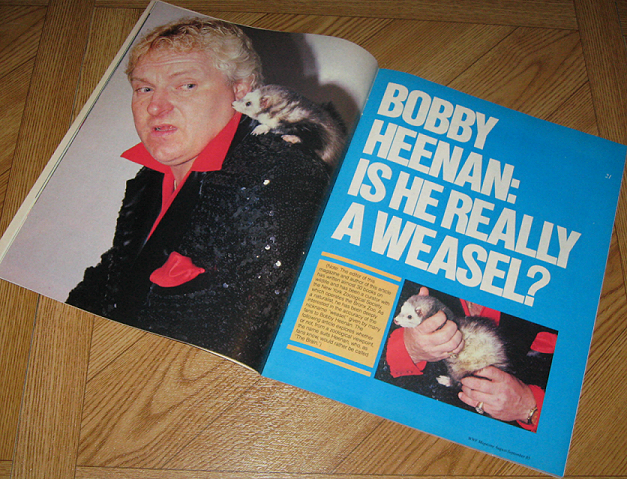
In his nearly decade long WWF-stint, Bobby "The Brain" Heenan was always a large part of WWF Magazine.  From having his own column to many articles about the Heenan family and his other devious antics, Heenan was as much a heat machine on the newsstand as he was at ringside.  Although he would get his own cover two years later, Heenan shines in an article examining his connection to his fan-given nickname of "Weasel" as well as the animal itself.

Keeping with the trend of profiling managers, another article focuses on one who had been with the company for quite awhile--Captain Lou Albano.  The Captain was appearing in the feature film "Wise Guys" with Danny DeVito and Joe Piscopo and the article includes behind-the-scenes photos.  A one-page article about WWF and Coliseum Video, a fluff piece discussing the latest releases, follows the Albano feature.

The cover article is next, with the photo-packed feature on Lauper's "Goonies" video that featured a plethora of WWF stars.  In addition to noting how massive the pirate ship set used in the video was, a particular photo of Freddie Blassie always stuck out to me.  This absolutely had to be one of the reference photos used by LJN when they created his figure.  The pose is identical down to the placement of the rings on his fingers.  The "Hollywood Fashion Plate" never looked better!

The marketing machine is back again with a page full of items that would command a high dollar today--early posters.  These would be even scarcer than the ones shown in the later merchandise catalogs which themselves are in high demand these days.  Posters of Hogan in three of his color combinations (blue and white, all white, and red and yellow) and Richter from her bikini shoot are particularly memorable.  The following pages feature early WWF logoed apparel.

$59.95!  There's the Coliseum Video price that most of us remember.  The "Andre the Giant," "Most Unusual Matches," and "Best of the WWF Vol. 2" tapes are showcased in a full page ad urging fans to order.  Although there were even some budget WWF videos released at the time, until WWF Home Video took over in late 1997, this was the price for most tapes.  Of course there were ways around this for fans to "bring home the action," but that's another story for another time.  The opposing page is the beginning of an article chronicling the feud between Freddie Blassie and The Sheik.  The Sheik, not the Iron Sheik.  This is a fact that the article points out.  Many of the early WWF Magazines not only feature stories on wrestling history, but also stars who were not in the organization of the time.  Jeff Walton, a name familiar to many wrestling fans, is the author of this article which is accompanied by several classic photos.

While the back cover is an advertisement for Tuesday Night Titans, it's the inside back cover that is memorable to so many fans.  "How Do You Get A Wrestler In A Mailbox?"  This is the ad to order the first five LJN WWF figures directly from the WWF Merchandise Department.  At only $10 each, how could anyone pass it up? 

This was the 1985 WWF.  These pages lavishly illustrate just how far this company was coming in both the fields of professional wrestling and entertainment.  An all-color, all-slick magazine was just the kind of publication that the progress of the rest of the company demanded.  I think the voice of the WWF at the time, Gorilla Monsoon, would've summed it up something like this...

"This magazine would be a best seller at any newsstand anywhere in the world!"

As usual where Gorilla is concerned, I would have to agree.