Showing posts with label The Battman. Show all posts

Thursday, November 18, 2021

The Territory Photo Albums--Pittsburgh 1969

Since its inception this blog has always had something of a Pittsburgh flavor. After all, I've made my home in Pittsburgh for my entire life. But "The Burgh" is somewhat underappreciated for its rich wrestling history. Of course we claim Bruno Sammartino as our own, but it's sometimes forgotten on a larger scale just how many big names of wrestling's past spent their time here. Bruno needed challengers, allies and plenty of other talent to fill out cards at the Civic Arena and on the immensely popular "Studio Wrestling" program.

The Pittsburgh wrestling office, like many territories, periodically released photo album publications to remind you of the great wrestling roster in your area. There were five total, all released under the banner of "Tri-State Wrestling." I've featured them on this blog before, with the 1967 edition being a previous entry in the "Territory Photo Albums" series, but today we're looking at the final one that was produced in 1969. 

While the first editon, published in 1963, has Buddy Rogers featured most prominently, Bruno has clearly become the star in his six years as champion. In fact this edition features more Bruno than anyone else. There's no doubt about it, though, he was the man. While most associate New York as his top town, you would be hard-pressed to find someone who grew up in Pittsburgh in the '60s who didn't know The Living Legend. The Italian Superman. The Champ. He was, and still is, a Pittsburgh sports icon revered alongside the likes of Roberto Clemente. 

Our cover features Bruno sharing the spotlight with Tony "Battman" Marino who we just recently lost. Marino is showing off his famous physique without the costume of The Caped Crusader covering it up. With the Batman television series being off of the air for over a year at this point, the gimmick was about to come to an end as well. Mr. Marino was a class act and is much missed. When I had this particular album signed, he even brought the original "Battman" cowl. Did I mention that the gentleman, well into his '80s at that point, had a patch of hair, on his otherwise bald head, shaved into the Batman logo? 

Inside we get Bruno right off the bat! It's actually the entire Sammartino clan. Carol, David and the twins. Despite what we know about Bruno and David's relationship later on, it's nice to see some family time shown here. This album also includes several pages dedicated to "The Bruno Sammartino Course Of Body Building." This was actually also released as its own publication around the same time as well and I would imagine that it set many a Pittsburgh youth off on the right foot as far as training is concerned. I won't go on a tangent, but there aren't any true role models left in sports today. Bruno was the role model in every sense of the term.

As mentioned above we get great glimpses of so many legends who either starred in the Pittsburgh area or at least passed through. Domenic DeNucci, Ivan Koloff, Lou Albano and Tony Altomare, Waldo Von Erich, Gorilla Monsoon and George "The Animal" Steele. We also have the Pittsburgh mainstays like Bobby "Hurricane" Hunt, Jumpin' Johnny DeFazio and Frank Holtz. The latter may actually be the final living Pittsburgh wrestling star of this era following the recent deaths of DeFazio, Marino and DeNucci.

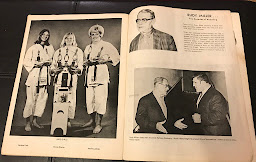
The Tri-State albums always featured bits on non-wrestlers, too, such as Pittsburgh broadcasting legend Bill "Chilly Billy" Cardille who was our voice of wrestling, promoters (including Vincent J. McMahon in one of the early books) and the man credited with discovering Bruno, Rudy Miller. This last installment also features a full page photo featuring three young women labeled "Judo Girls." Darlene Kalb, Donna Waxter and Jordie Ludwig were local judo champions who performed exhibitions during cards at the Civic Arena. I have no idea if the three are still with us, but adding their autographs to the book would certainly be fun as would hearing their stories from the era. 

While we always hear about WWF Magazine, pay-per-view event programs and other similar publications, very little is ever written about these great photo albums. I'm both thrilled and honored to document them for posterity. For more photos of this edition, including more of the autographs that I've filled this one with, follow us on Instagram @jws_wrestling_memorabilia. 

Thursday, October 18, 2018

Wrestling MarketWatch: Magazine Mayhem

Have there really been over thirty editions of our MarketWatch feature over the years? Sure, I just appropriated the title from CBS (my apologies to the "Eye"), but it's always a very fun feature to research and write. While I always champion the fact that collecting should be fun over profit, it is always a blast to see how much, or how little, certain items are currently selling for. It's the only way to have any sort of collectible "price guide" in this day and age. 

Seeing as that they increase and decrease in price perhaps more than any other form of wrestling memorabilia, we're once again looking at magazines. There are many wrestling magazine collectors out there, and for this edition we'll look at a variety of issues from various time periods that have recently seen movement on the market. As always, prices listed are for non-autographed versions.


*Where better to begin than 52 years ago this month? Batmania had swept the country thanks to the magic that was being created by Adam West and company on television every Wednesday and Thursday evening. Wrestling capitalized on the craze, though it was most prominent in Pittsburgh where strongman Tony Marino became "The Battman." Though he played the character for several years (and has the hair on the back of his head shaved into the Bat Signal to this day), his tag team partner dressed as Robin was short-lived. Both were captured in full costume on the October 1966 issue of Wrestling Revue magazine. While Batkids of the day probably readily scooped the magazine up from newsstands, it's a less common issue nowadays and recently sold for $31.


*Around 25 years later another colorful character would capture America's interest, that being Bart Man aka Bart Simpson. Bret "The Hitman" Hart made a cameo on The Simpsons right around what many consider to be the best era of the long-running cartoon. This appearance was immortalized on the cover of the May 1997 issue of WWE Magazine. Bret and Bart recently sold for $50 which is unusual for this particular edition.


*Going back to the late 1970's we see the fourth issue of the short lived Wrestling Action Magazine. The first in-house WWWF publication, this magazine has widely been featured here on the blog over the years, and thanks to editor Les Thatcher we've been able to chronicle the history of the highly collectible run. This issue features the war of the tag teams that was going on at the time pitting The Valiant Brothers and manager Captain Lou Albano against Larry Zbyszko and Tony Garea. The issue recently sold for $24.50 which is actually trending low for this magazine.


*Another titled to come from wrestling renaissance man Les Thatcher was the Mid-Atlantic Wrestling Magazine. One of my favorite covers in a run where it's hard to choose just one is from Issue Vol. 4 No. 5 featuring "Number One" Paul Jones and The Masked Superstar. If there were ever two stars who embodied wrestling in the Carolinas for Jim Crockett Promotions, it's these two gentlemen. The issue recently sold for $51.


*Finally we head back north in August/September 1984 with the World Wrestling Federation. "Rock N Wrestling" was at full steam and in the center of the mayhem were Rowdy Roddy Piper, Captain Lou Albano, and Cyndi Lauper. The three took the cover shot here, obviously on the set of Piper's Pit. As with many of the early WWF Magazines, secondary market value has rarely waned. This classic recently sold for $49.

From cartoon characters to pop singers to wrestling versions of Caped Crusaders, these issues embody the fun of collecting wrestling magazines from the past. What do you have socked away in "Mom's attic?" There could be great reading material up there...and a lot of value in it.

Thursday, October 29, 2015

Who Was That Masked Man?

It's that time of the year again. Pick out a mask and either ask for candy, pass out candy, or just go to a party. It's a long-standing tradition. For some in the wrestling business, a mask is part of their livelihood. From American stars like The Destroyer and The Masked Superstar, Japanese names like Tiger Mask and The Great Sasuke, to the many masked luchadores of Mexico, wearing a "hood" has helped create many a wrestling legend.

It's often been said that masked wrestlers have to work all the harder. After all, facial expressions cannot be seen outside of a mask. The masked wrestlers must utilize other ways of expressing themselves. The Masked Superstar is a great example of this. While many would say that his in-ring work spoke for him, no one can forget his intelligent yet calculating interviews. Bill Eadie worked hard to make what could have been a forgettable masked heel exactly the opposite. Before the matches even began, fans knew that Superstar's heroic opponent was in for a true battle. In the opposite direction, Mr. Wrestling II worked a similar way. Throughout most of his run, Wrestling II was able to capture the hearts of fans rather than strike fear into them. Famously captivating the mother of President Jimmy Carter as one of his biggest fans, the charismatic Mr. Wrestling II became a staple of southern-based wrestling promotions for over a decade.

Sometimes two is better than one, and in the case of The Assassins it meant double trouble. The familiar black and yellow masks were honestly a bit unsettling to begin with and their in-ring work backed up their villainy. There were a few wrestlers under the Assassin masks over the years, but Tom Renesto and Jody Hamilton are probably the most celebrated. Younger fans will remember Hamilton for his involvement with WCW as The Masked Assassin in the mid-1990s. Hamilton also released a great book about his many different roles in wrestling, including running a WWE developmental territory.

It's Mexican wrestling that is probably best known for masked stars. Lucha libre was built upon superhero-style grapplers who took to the mat and the air equally. It's hard to imagine in the United States, but several legendary luchadores became God-like in their popularity in Mexico. El Santo is one of those stars. Wearing his famous silver mask, El Santo ruled both lucha libre and Mexican pop culture for decades. Appearing in the ring and starring in many motion pictures, comic books, and other media, his popularity was so that his funeral in 1984 is said to have been comparable to a president or other top state figure. Both he and his legendary rival Blue Demon have had their masks handed down thus continuing their mysterious legacies.

Another masked luchador, Mil Mascaras, has seen popularity in Mexico, the United States, and Japan. While he garnered a reputation of being somewhat difficult to work with, it should not take away from his in-ring legacy. As has been discussed before on this very blog, Mascaras is the classic masked luchador who has been merchandised the most outside of Mexico. Thanks to an omnipresence on the covers of 1970's wrestling magazines and a glut of merchandise from Japan, the many masks of Mil Mascaras have been seen the world over with no end in sight.

Japan has created its own masked stars as well, with the look and style fitting well into the wrestling culture of the far east. Tiger Mask, in various incarnations, has been thrilling wrestling fans for over thirty years. As originally portrayed by Satoru Sayama, Tiger Mask toured around the world, perhaps most famously in matches against the equally agile Dynamite Kid. Jushin Liger, with his horned mask and long black hair, became another popular lightweight star and is still gaining fans such as in his recent NXT appearance. Both of these characters were ripped from the pages of Japanese manga books, thus instantly producing real life super heroes.

Of course, it was Rey Mysterio Jr. who carried the masked legacy into the modern day mainstream world of ECW, WCW, and WWE. Mysterio's underdog personality and fighting spirit made it easy for him to connect with fans. It could even be argued that Mysterio's lowest career point was a brief stint where he was unmasked. Once again, the mask became an irreplaceable part of a wrestling career and legacy, not to mention a huge cash cow for WWE once Mysterio was properly introduced by the company's legendary marketing machine.

WWE has not fared well in trying to recreate the Mysterio magic. Still, the popularity of Lucha Underground and other recent outlets prove that it can still be done in the United States. I would love to see the return of a Masked Superstar-style star. A masked villain who is as heelish as he is mysterious. It could be done, and would actually be a fresh idea after being on the shelf for so long.

Who were those masked men? Maybe you'll be inspired to hit the Halloween streets dressed in honor of one of them. After all, many wrestling masks were designed to instill fear in the hearts of opponents. Other wrestlers had faces that were designed perfectly to be right on masks themselves...


Happy Halloween, pencil-necked geeks!

Thursday, July 31, 2014

The Territory Photo Albums--Pittsburgh 1967

 Fans nowadays have it easy!  If they want to know who's officially on the WWE roster, they can simply pull up the WWE App and a fully interactive listing is available at their disposal, complete with photos, facts, and even videos.  Back in the territorial days of wrestling, this would've been looked at as something out of science fiction.  The more advantageous fan might contact or even visit the offices of their local wrestling promoter in order to gain more info and facts, but that was about as far as it went.  If the fan wanted a "Who's Who" of wrestling stars and info they could usually purchase a program at an event, but one item was just a tad better: the photo album.

Most territories eventually released a publication billed as either a photo album or something similar.  These books were program/magazine sized and printed on a variety of materials.  Some had color, some did not.  Some had thicker, sturdier covers while others were all on standard paper.  A few were produced by the promotion itself, while others had some help from other publishers.  No matter the differences, they all served to advertise and promote the talent to the masses.

Since so many different albums were produced, it'd be an injustice to lump them all into one entry.  As a continuing series, we'll take a look at photo albums from territories around the country featuring many of the all-time greats and even some forgotten names.  For a few reasons, we'll start right here in the home city of this very blog, Pittsburgh, PA.

The photo albums put out by the Pittsburgh wrestling office, known as Spectator Sports, were titled "Tri-State Wrestling."  To many, they're known as the "Studio Wrestling photo albums," as "Studio Wrestling" was the name of the much-missed Pittsburgh wrestling television program, most famously hosted by Bill Cardille.  Growing up, I would constantly hear the WWF and other then-current wrestling promotions referred to as "Studio Wrestling" by adults.  I later figured out that the name is simply what these folks grew up on, so it became a generic title for which to refer to any form of pro wrestling.

Five of the Pittsburgh Tri-State Wrestling photo albums were produced in all, ranging from roughly 1963 to 1969.  The albums were sold through advertisements on arena programs and on the Studio Wrestling show itself.  For a nominal fee, you could own an album showing you full page shots of your local wrestling favorites, and even some national stars that were thrown in for good measure.  In the days before the over-saturation of televised wrestling, not to mention the Internet, these albums were the kind of thing that fans stared at for hours.

Exact release dates on these albums are fuzzy at best, but most agree that the edition shown here today is from around 1967 and would've been the third of the five released.  As with all but one of the Tri-State albums, the WWWF Champion Bruno Sammartino is featured in a classic pose on the cover.  These Tri-State covers were usually very colorful, and this one is a mix of color and glorious black and white.  Interestingly, Sammartino is referred to as the "Holder Of World-Wide Wrestling Federation Championship."  It is often recalled that the title was usually just referred to as the "World Championship" on Studio Wrestling broadcasts.

In addition to being fun to look at, these albums also often provided a great place to obtain autographs in those very early days of wrestling merchandising.  Subsequently, it is not unusual to purchase any territorial photo album that contain signatures.  Long time readers of this blog may remember this Tri-State album, as I once uncovered a photo of the late Chief White Owl autographing the cover of one.  Whether or not this is the exact one or not will never be known, but the one in my collection does indeed have White Owl's signature right on the cover.  I've since been able to add Sammartino's signature as well as other living Pittsburgh wrestling legends, but it's always interesting to see just who the original fan was able to meet up with all of those years ago.

The Tri-State albums are a mix of promotional style photos and action shots.  In addition to men who competed in the Pittsburgh and Western Pennsylvania area like Sammartino, George Steele, Gorilla Monsoon, Bill Miller, Johnny DeFazio, and The Battman are wrestlers who had either passed through the area at one time or may never have really spent any time here at all such as Bobo Brazil, Arman Hussain, Toru Tanaka, and Luke Graham.  It was a smart idea by the Pittsburgh promoters to make the promotion seem even larger and more important.

Another fun gimmick that the promoters used to make the promotion seem larger can be seen in several of the photos, most notably in the in-ring photo of Steele.  Though crowds at the WIIC (now WPXI) studios were boisterous, fake fans made of cardboard helped to fill out certain sides of the ring in an attempt to make the studio seem even larger.  In the days before high-definition television cameras, this most likely worked to a degree, despite being blatantly obvious here in print.

Speaking of the studio, it seems that the original owner of this album most likely attended a live television broadcast of Studio Wrestling.  The thought behind this is the inclusion of the two gem autographs of the album, the first of which is promoter Rudy Miller.  Miller is often credited with discovering Bruno Sammartino himself, and is in fact listed as such right here in the album.  Although he was probably accessible for an autograph, it likely didn't occur to many fans to ask him for one.  After all, he wasn't a wrestler.  Also shown on the page are various officials, the ring announcer, and Dr. Louis R. Civitarese.  Civitarese, who passed away in 2012 at the age of 92, was the doctor who attended to Sammartino when the legend broke his neck in the 1970's.

The other star autograph in the album is also of a man who was not a wrestler, but rather a baseball Hall of Famer.  Pie Traynor, legendary Pittsburgh Pirates third baseman, is best remembered in the city today for being the pitchman for American Heating Company.  Traynor would do live commercials during the Studio Wrestling program where he would proclaim "Who Can? AmeriCAN!" to a generation of steel town wrestling fans.  Today, mentioning either Traynor or Studio Wrestling to a Pittsburgher above the age of 55 will likely produce an imitation of the famous pitch.

I have a soft spot for Pittsburgh for many reasons that I've covered over the years, but looking through the photo album of any wrestling territory is a thrill.  They're yet another great relic of the wrestling business gone-by, but in some ways they're continuing today.  In upcoming editions of "The Territory Photo Albums," we'll take a look at all aspects of such publications, and I hope that the stars pop out of these entries the way that they do in these albums of ten, twenty, and even fifty years ago.

Thursday, February 14, 2013

From The Musty Yellowed Pages--Bruno: A Collector's Item

The mainstream media is finally catching up to me!  All it took was a new relationship with WWE and everyone and their mother is writing about Bruno Sammartino.  Never to be outdone, especially where Pittsburgh's own Living Legend is concerned, I'm giving you two Bruno blog entries in a row!  Whereas last week was my own gushing over the recent happenings between WWE and Bruno, this week is another entry in our ongoing "From The Musty Yellowed Pages" series where we take a look inside of a wrestling publication.

This particular magazine about "The Living Legend" doesn't really have a title.  It's essentially called "Bruno," but since there is a small "A Collector's Item" tagline under Bruno's cover portrait, we're officially going to refer to it as "Bruno: A Collector's Item."  Although most items labeled as a collector's item rarely reach that status, this magazine breaks the rule.

Beginning around late 1970, ads and order blanks for this magazine began appearing in Wrestling Revue.  It was not available on newsstands and thus is much harder to find some forty years later than the standard Wrestling Revue issues.  At one point several years ago, this magazine sold for several hundred dollars.  Some collectors still believe that they are able to sell their own copies for that much, but I have yet to see proof.  The large amount was probably the result of two overzealous collectors bidding on one copy.  That being said, anyone owning this magazine should know that they own one of the nicest vintage Bruno collectibles around.

One striking feature of the magazine is that the cover folds out to a full-color poster of one of Bruno's most iconic shots.  On examples found today there is often much wear and tear on the cover and spine.  This is most likely due to fans folding and unfolding the poster.  Although there is some text, this is mainly a photo album covering Mr. Sammartino's entire life to that point.

There are no known photographs of very young Bruno due to his family's situation in his home country of Italy.  The earliest photos of Bruno were taken once his family had settled in America after World War II.  Many of these shots include his parents and siblings.  These photos are included here, as are pictures of Bruno's wife and children including David.  Many photos in this section and throughout the magazine were used in Bruno's 1990 autobiography.

Aside from posed photos, anything "backstage" in those days was relatively rare.  In a section entitled "Bruno And His Fans" we see a shot of Bruno visiting with a disabled child during the course of a show.  The ever-gracious champion did a lot of this kind of thing, something that many wrestlers, such as John Cena, continue to do today.  Also on this page are shots of Bruno signing autographs including a great in-ring shot where the champ is accompanied by tag team partner Tony Marino, dressed in his complete "Battman" costume.

One full-page shot features Bruno and one of his heroes, the legendary Primo Carnera.  Carnera, largely known as a professional boxer in his heyday, became a professional wrestler after World War II.  Also dabbling in acting, most notably in the original "Mighty Joe Young," Carnera teamed with Bruno in the twilight of his career.  Bruno has said that while teaming with his hero was a great thrill for both himself and his family, the fact that Carnera was in less than spectacular shape and still forced to wrestle made it somewhat bittersweet.

Bruno was also no stranger to personal appearances.  A section entitled "Bruno At The Fair" shows the champ at the "Shaefer Circle of Sports Exhibit" signing his name in cement and posing while mightily hoisting two beer barrels in the air.  The latter is actually one of the final stories told in his autobiography.  The press set up the stunt for a photo op and even the mighty Bruno could barely wait to put the huge barrels back down on the ground.  After the event was over, Bruno removed his sports jacket only to see his white shirt stained with blood.  The barrels dug so deep into the strongman's arms that they cut into his skin.

For many, the highlights of this magazine would be a collection of sections featuring Bruno against his top opponents.  Many of wrestling's all-time greats from Gorilla Monsoon to Fred Blassie to Bill Watts are included here.  In the section featuring Ivan Koloff, it notes that the Russian Bear has never defeated Sammartino.  We now know that not long after publication this fact would change.  Wrestling Revue featured great writing over its run on the newsstands but the amazing action photography is what truly sold the magazines.  Those fine photos are what we see here.  Since so much of his early career was not captured on film, these photos provide an excellent view into the Hall of Fame career of Bruno Sammartino. 

Another top opponent of Sammartino featured is Killer Kowalski.  The feud between these two classic grapplers raged on throughout the 1960s and 1970s.  A deep mutual respect developed between the two that Bruno still talks about to this day.  In recent media coverage, Sammartino has cited Triple H's respect for Kowalski (who trained the WWE star) as a point that Sammartino in-turn respects regarding Triple H.  In the magazine we get an amazing photo of a presumed contract signing between the two legends.

The magazine concludes with a look at Bruno wrestling in other countries including Australia and Japan.  Sammartino was fiercely loyal to Giant Baba who went on to found All Japan Pro Wrestling.  Two action shots of Bruno and Baba are included.  A classic mail-order ad for Bruno Sammartino Buttons is to the left of these photos.

Bruno Sammartino is one of the few 1960's stars that has a seemingly endless supply of merchandise.  It's a true testament to his popularity, in an era when merchandising was virtually non-existent in wrestling.  There's no doubt that we will be seeing new Bruno DVDs, trading cards, action figures, and video game appearances thanks to his new deal with WWE.  As soon as they're available, you'll be hearing about it right here, but I'm not quite sure that any of them will measure up with "Bruno: A Collector's Item."

Tuesday, September 13, 2011

Wrestling MarketWatch: High End Hijinx

With the financial state that pretty much the entire world is in, it should be amazing to anyone that many collectibles are still selling for the prices that they do. While I'll still argue that it's a buyers market as far as wrestling memorabilia is concerned, many items are still getting well over $50 in the secondary market.

In this installment of our recurring "Wrestling MarketWatch" series, I'll take a look at some of the recent selling prices on various items that have went above and beyond what many would think their value might be. As always, I caution that "value" is simply what someone is willing to pay for an item at a specific time. Should you go to sell the exact same item you may not get nearly the same price. It's all about supply, demand, and advertising/describing the item properly.

*We'll start with a perennial favorite among both wrestling collectors and children of the early '90s who've grown up and want their toys back. The Tonka WWF Wrestling Buddies have stood the test of time in terms and popularity...and durability. While these toys do fetch high prices there are also a ton of them out there. That can only bring one conclusion: fans simply like these things! What's not to like? Fun cartoonish caricatures of your favorite early '90s WWF stars that are sized and made to be WRESTLED with. While prices vary depending on which wrestler it is, the very popular Ultimate Warrior buddy has recently been selling for around $50 out of the box. If you've got the box, the Warrior and other stars can soar to $100 and beyond.

*Back to the year 1966 and cartoon characters of a different kind. While Bruno Sammartino ruled the northeast, he obviously couldn't be the sole hero of the area with the evil threats of Killer Kowalski, Gorilla Monsoon, and other villains of the mat. In Pittsburgh, the champ had help and an ally in the form of The Battman. No, not Batman. The Battman. Yeah. Trademarks you know. Well, the original outfit (and sidekick) would've never stood up in court these days, but nonetheless the Pittsburgh area had its own wrestling Dynamic Duo. Veteran wrestler Tony Marino virtually had a second career portraying the ring's version of the Caped Crusader. To this day, the 80-year-old Marino wears Bat Signal-shaped hair on the back of his head. Back in '66, the character made the cover of the October issue of Wrestling Revue magazine. Although certain covers of the now-defunct magazine have always sold well, this particular copy of the magazine recently sold for an amazing $202! Holy Rasslin' Relics!

*Although they didn't have quite the marketing machine of the WWF at the time, Jim Crockett Promotions produced a nice selection of merchandise that has become much sought after in recent years. The last major merchandising venture that Crockett would embark upon before being bought out by Ted Turner was a partnership with Wonderama International. The company ended up producing a set of NWA Wrestling Supercards. Featuring The Four Horsemen, Dusty Rhodes, Sting, The Road Warriors and hordes of others, the set is massive (around 350 cards) and, due in part to the offbeat nature of some of the photos used on the cards, a load of fun to collect. Since the set is indeed so massive, the easiest way to obtain one is by purchasing a complete set. These sets often include original cardboard boxes designed for the cards. Recently a set with box sold for $65. Although that isn't quite pocket change these days, I still advise collectors to pick this set up when they see it.

*I've discussed the WWWF Wrestling Action magazine quite a few times. It's a five issue set that just happens to be the first publication sanctioned by the WWWF. Prices have never been stable on these ranging from $10 to well over $100 for each issue depending on when you decide to buy. All five issues, as described here, have amazing covers chronicling the late '70s WWWF. The last issue, which is actually under the WWF banner, recently sold for $53. This and other recent prices for the magazines indicate to me that demand is on the rise again. While each issue shows up on occasion by no means are they common.

*Finally we come to a favorite of so many collectors: the LJN WWF figure line. Like with so many collectibles, packaging can often be the key to value. The LJN tag team figures greatly resemble this remark. Although the tag team sets show up somewhat frequently and usually obtain several hundred dollars each, the tag team figures packaged on cards and sold separately are a whole different story. The Killer Bees, Hart Foundation, and Strike Force individually carded would be a treasure to anyone but The British Bulldogs have become the most fabled of them all. The figures are even backed on Hulk Hogan card backs as opposed to having "clip and save" file cards of Davey Boy Smith and Dynamite Kid. Examples of each were recently sold at auction for $1,700 (Davey) and $1,009 (Dynamite) respectively marking the highest known prices for individually sold wrestling figures in recent memory.

What kind of treasures do you have stashed away? Would they carry the monetary bite of the Bulldogs or the ultimate popularity of Wrestling Buddies? As I always remind everyone, the true value is how much it's worth to you as an item. You can't go wrong investing in what YOU like. Holy Final Thought!

****"From The Musty, Yellowed Pages..."****

WWE Magazine, March 2007, Page 12

Although the pages of a four-year-old magazine probably aren't quite yellowed, I could think of no better "Musty, Yellowed Pages" segment to tie in with the recent selling price of the LJN Dynamite Kid.

In '07 the publishers of WWE Magazine decided to use a few photos of some of my items. I decided to highlight the Dynamite Kid LJN figure, as even toy magazine price guides were listing astronomical values for the figure and I myself had seen less than five examples of the piece. Despite TWO fact checking calls from the magazine, they still misquoted me by proclaiming the figure to be a "rare one-of-five" figure. I had told the magazine on three occasions that I had only ever SEEN around five or less in my collecting years. To this day I have still only seen around eight floating around, although I'd guess that a few more do exist.

Regardless of their mistake, I was still honored to be in the magazine. Now I'm writing about them. Coming full circle? Maybe.