A silent crowd, polite applause, perhaps a few crepe paper streamers, and some of the best in-ring action you'll ever see. These were the glory days of puroresu aka professional wrestling in Japan. Antonio Inoki, Giant Baba, Mitsuharu Misawa, Tiger Mask, and even domestically known names like Stan Hansen, Andre the Giant, The Funk's, and Abdullah the Butcher dominated Japanese culture for years perhaps even more than the country's other sports and entertainment icons.
It's actually quite unimaginable in the United States as to just how big professional wrestling and its stars were in the Land of the Rising Sun. While domestic wrestling has always had niche fans and "boom" periods of fad popularity, wrestling in Japan enjoyed mainstream popularity and coverage for several decades.

That is, of course, where the memorabilia comes into the picture.
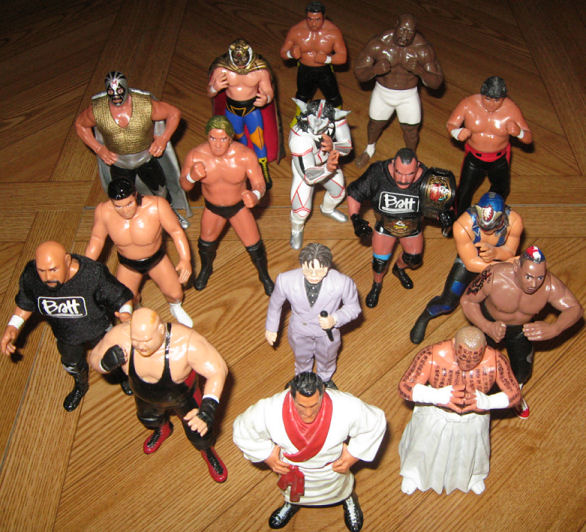
Not only was Japan the birthplace of many gimmicks, moves, angles, and ideas in pro wrestling, but it was also the home country to the very first wrestling action figures. A company called Popy, also manufacturer of the Tiger Mask action figure line (based on the cartoon from which the Tiger Mask character was born), created a small line of wrestling figures in the early 1980's. This series, including Inoki, Andre, Hulk Hogan, and Harley Race among others, is very hard to find and valued highly to this day.

In the 1990's when the Japanese in-ring product was often regarded as the best in the world, several lines of quality figures began being produced. Every promotion of the time including New Japan Pro Wrestling, All Japan Pro Wrestling, Pro Wrestling NOAH and others got into the act with figures produced by a wide variety of companies such as Hyper Heroes, HAO, Character Product, and more.
Although figures were produced in several different sizes, the most popular would likely be the five inch figures which were made under each company's banner. As much as the Jakks Classic Superstars line should be celebrated for including stars from so many different eras, these five inch Japanese figures cover eras, companies, and countries with stars ranging from Mil Mascaras and the Funk's to Jushin Liger and Ultimo Dragon. Special outfits, accessories, and other "deluxe" features were included with many of the figures while others commemorated special matches or events based on their design. Ring announcers, referees, managers, and even a pair of ring girls known as the "Break Bunnies" were produced into figures along with rings, belts, and even ring accessories such as barbed wire and (plastic) flames!

Nearly all of the five inch figures included a universal feature: removable arms. For some of the figures this fact made no difference at all. For others, like Jinsei Shinzaki/Hakushi, two pairs of arms were included with the figure to create different poses. Others yet, like Satoru Sayama, included a different torso to transform the popular light heavyweight into his guise as the original Tiger Mask.

These figures hit the height of their popularity in the early 2000's which was a time when MMA was heavily crossing over with pro wrestling in Japan. Many MMA figures were produced in the country by the same manufacturers and collections often include figures from both, especially of those who starred in both sports. One notable example would be American "The Beast" Bob Sapp who was one of the biggest cultural stars in Japan at the time.
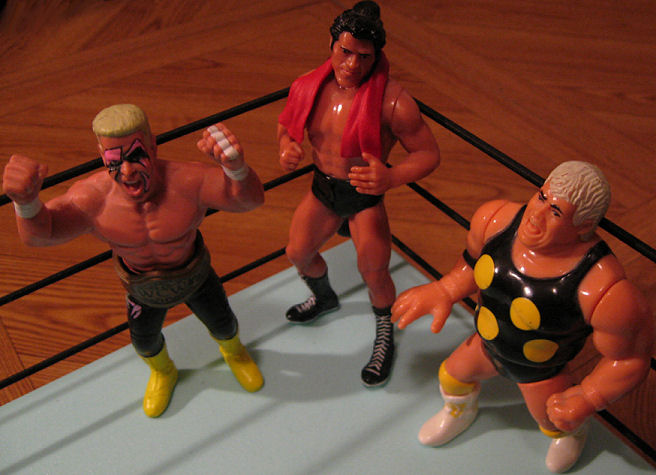
American collectors often wonder just how these figures measure up in size compared to popular lines from their country. The main five inch Japanese figures fit perfectly with the Hasbro WWF and Galoob WCW lines making many dream matches...or displays...possible.

Of course the five inch figures were just one style. Large figures, small figures, "big head" figures, and even 3 3/4 inch G.I. Joe-esque figures were released of stars from across the span of puroresu. While some may argue that many of these pieces were more statues than figures, the attention to detail and quality craftsmanship place these at the top of any collection.
One interesting thing that I have come across in collecting Japanese figures is the reactions of the stars when seeing these pieces. Dory Funk Jr. and Scott Norton were unaware that figures of themselves even existed. Although the individual licensing rights are listed on the bottom of the back of the cards of many of the figures, perhaps the rights were attained in deals that the stars themselves were unaware of.

Over the past couple of years the figures have unfortunately ceased production. With the popularity of wrestling on the decline in Japan, this did not come as much of a surprise. When Jakks conceived their TNA line follow-up to the WWE Classic Superstars line, rights to New Japan Pro Wrestling figures were acquired. The NJPW version of Hulk Hogan was ultimately the only figure to come from this deal, but at least the NJPW logo was included on the packaging.
As in America, action figures were just a tip of the iceberg as far as wrestling merchandise in Japan. Publications chronicling wrestling far surpass those in other countries due to the aforementioned mainstream appreciation that the sport achieved there. From newspaper coverage to the famous Weekly Gong magazine, Japanese wrestling publications are abundant and a lot of fun to collect. Many of the magazines include coverage of American wrestling as well, often providing a different look at events well known to many of us.

Video games, trading cards, plush toys, and of course tons of recorded media are all just as treasured in puroresu collecting as action figures. VHS tapes of Japanese wrestling shows were among the top traded wrestling shows of the 1990's due to quality of matches and talent involved. Games like Fire Pro Wrestling are often considered the best wrestling video games which, like the action figure lines, included stars from a wide spectrum.
When it comes down to it, the figures remain king. Prices for almost all of the figures have risen since their initial release and continue to be discovered by new collectors. At the height of their release, some online stores would take pre-orders for some of the figures due to the process of importing the items. While the prices were higher than domestic equivalents even then, in retrospect they seem rather low compared to the secondary market numbers now.

Here is only a small sample of this great, and often overlooked, aspect of wrestling action figure collecting. I'm sure that we'll revisit the topic in the future on the blog, and to see many more of these figures and loads of other great memorabilia, "Like" and check out the galleries on our
Facebook Fanpage.
Ichiban!


 It's often been said that masked wrestlers have to work all the harder. After all, facial expressions cannot be seen outside of a mask. The masked wrestlers must utilize other ways of expressing themselves. The Masked Superstar is a great example of this. While many would say that his in-ring work spoke for him, no one can forget his intelligent yet calculating interviews. Bill Eadie worked hard to make what could have been a forgettable masked heel exactly the opposite. Before the matches even began, fans knew that Superstar's heroic opponent was in for a true battle. In the opposite direction, Mr. Wrestling II worked a similar way. Throughout most of his run, Wrestling II was able to capture the hearts of fans rather than strike fear into them. Famously captivating the mother of President Jimmy Carter as one of his biggest fans, the charismatic Mr. Wrestling II became a staple of southern-based wrestling promotions for over a decade.
 It's Mexican wrestling that is probably best known for masked stars. Lucha libre was built upon superhero-style grapplers who took to the mat and the air equally. It's hard to imagine in the United States, but several legendary luchadores became God-like in their popularity in Mexico. El Santo is one of those stars. Wearing his famous silver mask, El Santo ruled both lucha libre and Mexican pop culture for decades. Appearing in the ring and starring in many motion pictures, comic books, and other media, his popularity was so that his funeral in 1984 is said to have been comparable to a president or other top state figure. Both he and his legendary rival Blue Demon have had their masks handed down thus continuing their mysterious legacies.
 Japan has created its own masked stars as well, with the look and style fitting well into the wrestling culture of the far east. Tiger Mask, in various incarnations, has been thrilling wrestling fans for over thirty years. As originally portrayed by Satoru Sayama, Tiger Mask toured around the world, perhaps most famously in matches against the equally agile Dynamite Kid. Jushin Liger, with his horned mask and long black hair, became another popular lightweight star and is still gaining fans such as in his recent NXT appearance. Both of these characters were ripped from the pages of Japanese manga books, thus instantly producing real life super heroes.