Showing posts with label Les Thatcher. Show all posts

Thursday, June 29, 2023

From The Musty Yellowed Pages—NWA Wrestling Magazine Vol. 1 No. 1

After nearly fifteen years of maintaining this blog, at times I forget everything that I have, or haven’t, covered. I felt for certain that we’d taken a voyage through the debut, and only, issue of the NWA Wrestling Magazine. Aside from some mentions here and there, as well as plenty on its sister publications, I don’t think that it’s been done. Wait no longer, NWA fans, the time to revisit an era when the territories were king, Terry Funk was champion and Jesse Ventura was “The Great” instead of “The Body” has finally arrived.

Yes, this publication had just the one issue. Could you think of a better cover for just one issue of the NWA Wrestling publication? I can’t. If it reminds you of the WWWF Wrestling Action and Mid-Atlantic Wrestling magazines it probably should. It was done by the same artist, Cal Byers, and wrestling renaissance man Les Thatcher was at the helm of all of them. Wrestling, broadcasting, training, promoting and publishing. He did it all and has the stories to tell about it. I’ve had input from him while covering the aforementioned publications here on the blog and I still remember how surprised he was to see a copy of this one when he signed it awhile back.

More familiar names come about when looking at the list of contributors from then-NWA President Eddie Graham to Gordon Solie, Freddie Miller, Paul Boesch, Larry Matysik, Jeff Walton and Gene Gordon. The magazine covered all of the NWA wrestling hotbeds of the era and seemed to want to devote adequate press to all of the big territories. Even NWA members in other countries were not to be excluded. After all, this was the only publication to be “sanctioned” by the National Wrestling Alliance!

Though he was still relatively new to the game that he would eventually become the dirtiest player of, it’s telling that Ric Flair is the topic of one of the first features of the issue. The Crockett’s knew what they had and that’s why he was proudly displayed as the Mid-Atlantic Heavyweight Champion. You’ll note the famed Mid-Atlantic Championship Wrestling logo adorns the article here. As noted with all of the Thatcher publications, the art direction was second-to-none. There are logos for most, if not all, of the NWA territories featured within. In the late ‘70s this isn’t something that I would expect in a wrestling magazine at all, but here it is.

More familiar names pop up with looks at Georgia Championship Wrestling and Gulas Wrestling Enterprises Inc, the latter of which being the fabled Memphis wrestling territory. We have great color photos of Dick Slater, Mr. Wrestling II and Jerry “The King” Lawler. We also get a printing of one of my favorite Memphis photos displaying Jackie Fargo, Jerry Jarrett, Tojo Yamamoto and…George Gulas. Ok, so three out of four isn’t bad as far as levels of greatness. Still, I’ve always liked that photo ever since I saw it grace the cover of an “NWA East” edition of “The Wrestling News,” probably around the same time.

A very different Terry Funk than the version many are familiar with today graces the centerfold of the first and only NWA issue. This isn’t the “middle aged and crazy” Funker that’s so beloved today, but rather a tad more serious NWA World Champion who was continuing on the family’s championship legacy. I often talk about how much I admire wrestlers who are able to successfully reinvent themselves during the course of their careers. Terry Funk may own everyone else when it comes to that. I could picture the later Funker taking a flaming branding iron to the attire he’s wearing here. From champion to legend, that’s for sure.

One of my favorite pages in the issue has always been the feature on Chavo Guerrero. Talking about his famous exploits in the rings of California, it gives you an idea that Chavo may be one of the more underrated stars of the decade. I feel that his popularity was of the type that you really had to be around for to experience. I also think that, through no fault of his own, the popularity of brother Eddy may have overshadowed Chavo’s legacy. Still, ask most any wrestler who was around at that point and they’ll tell you what a huge star Chavo was in the business. A family photo here really tickles me as we get to see young Chavito, who we all got to know better many years later. Pepe was not invited to participate in the photo.

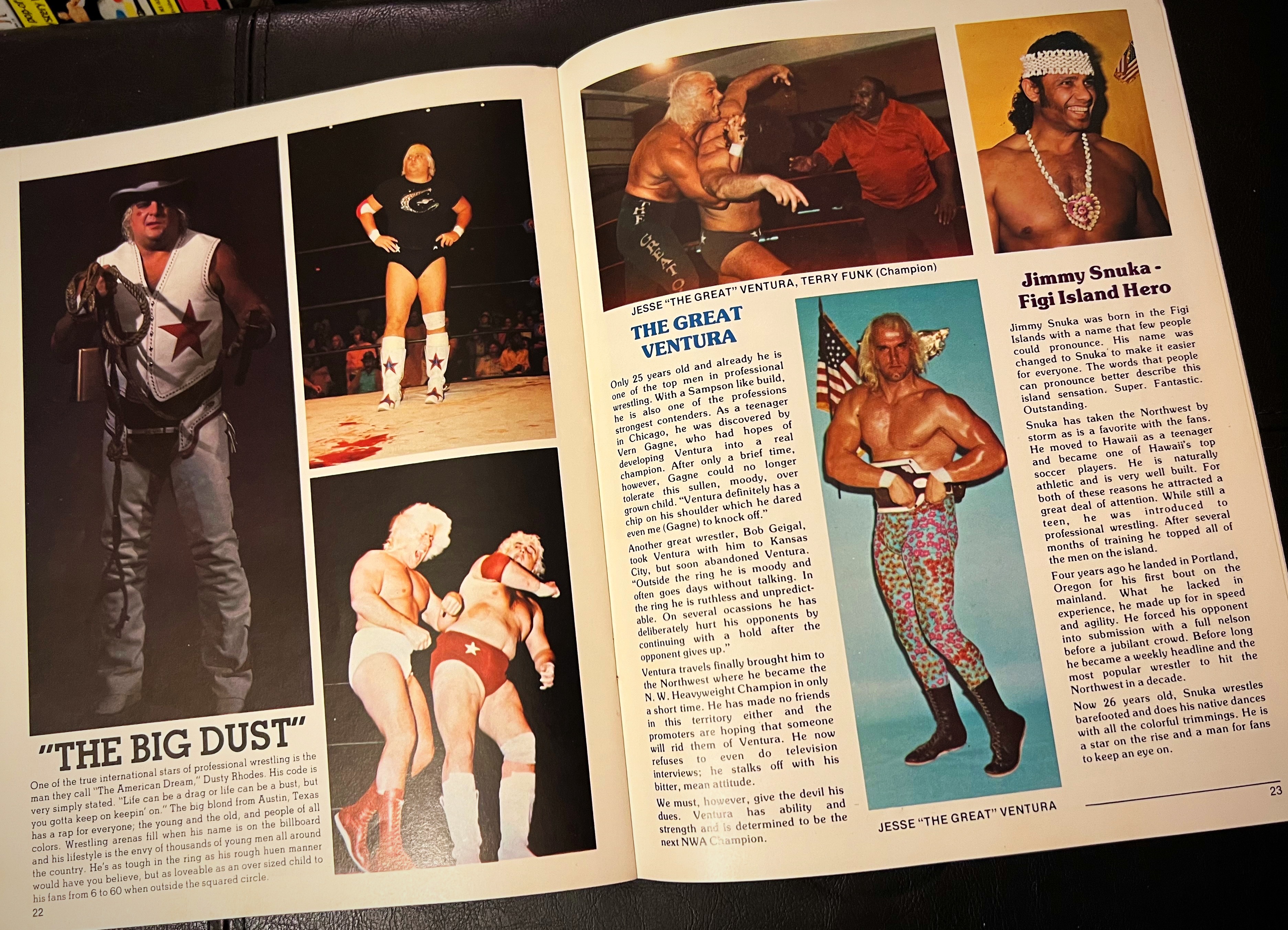
“The Great Ventura?” What? Yes, before he was “The Body,” Jesse was just “The Great.” I think we can all agree that “The Body” fit and rolled off the tongue much better. He has a short blurb in the magazine right alongside the likes of Dusty Rhodes and Jimmy Snuka. It’s amazing to think how many bonafide all-time greats came from wrestling in the ‘70s. I truly believe that the territorial system helped in that regard and would’ve been beneficial to many wrestlers in the past twenty years who seemed destined for greatness. In the old system you could try different things, work plenty of different opponents and move along when things got stale. Sadly, many of the newer generation stars had virtually “one and done” shots thus robbing us of quite a few talents who could’ve made it to superstardom.

Speaking of “one and done,” those are just some highlights of this, the only issue of NWA Wrestling Magazine. There are more photos and articles to peruse and you can see several of them on our Instagram account right here! Despite their age and rarity, copies of this magazine do show up available but almost always at a price. You never know, some shrewd searching may yield one for your collection. It’s certainly worthy as a collection centerpiece for any fan of the NWA, Terry Funk or just the last great wild west era of wrestling – the ‘70s!

Thursday, April 28, 2016

WWWF Wrestling Action #1

I've always been very proud, and humbled, that this blog has simultaneously opened discussion and answered questions regarding wrestling memorabilia and merchandise while even helping to discover certain items altogether. As I often say, wrestling is a genre of collectible that has been relatively unexplored and uncataloged. Even with all of the action figures, cards, and programs, among other items, that have been discussed here, by far the most storied is the five-issue WWWF Wrestling Action magazine.

The magazine was the very first in-house authentic World Wide Wrestling Federation publication. While the many great magazines already on the market featured a ton of coverage regarding the McMahon-owned promotion and its stars, this was an entirely different animal. Publisher (and as I like to call him, "wrestling renaissance man") Les Thatcher brought an elegant design to the magazine that he similarly instituted in his Mid-Atlantic and NWA Magazines. A lot of color, slick pages, and amazing illustrated covers were a staple in the Thatcher publications.

A few blog entries have already been dedicated to Wrestling Action, but I have always wanted to take a look at each individual issue, highlighting the best and most interesting features. This is the first of five, going in order. You'll note that despite only lasting five issues, the title actually spanned around two years. In the wild days of 1970's wrestling, it's no surprise that even publications were a bit erratic. Nonetheless, the five issues that we did get have spawned their own legend in wrestling memorabilia.

The first issue, officially titled WWWF Wrestling Action Vol. 1 No. 1., starts off with a bang right on the front cover. Superstar Billy Graham had just dethroned the legendary Bruno Sammartino for the WWWF Heavyweight Championship. As with Sammartino's first championship defeat, fans were shocked and saddened. Graham, however, did have his own fanbase. Many, including Graham himself, feel that his title run could have lasted a lot longer and possibly even included a stint as a babyface. While we will never know how that would have turned out, perhaps a glance forward at Hulk Hogan's initial run may be a bit of an indication.

When I completed my own set of five Wrestling Action issues, it was still possible to collect a fully signed run of the "stars" of each cover. For the first issue I obtained Graham as well as publisher Les Thatcher and famed wrestling photographer George Napolitano. Almost all of the issues elicited a great response from the signers. This first issue was no different. Obviously, even the stars themselves look back on this publication with fond memories.

Each issue has a small "As I See It" column allegedly penned by a major name in the WWWF. For this first issue it is then-WWWF President Willie Gilzenberg. The first regular feature is a story regarding Bruno Sammartino and his vow to avenge his April 30, 1977 loss to Graham. The photo of Sammartino used here would be the basis for the cover of the second Wrestling Action issue. Also of note here is an attached subscription card advertising a deal of six issues for $9.00. Quite the deal now, even considering that we now know that the magazine would only last five issues.

The Sammartino-Graham story is continued on the next two pages with some great photos in full color. Several photos are from the aforementioned title change in Baltimore. Keeping with Bruno's character, the champ is said to have claimed that he would have been happy had the title went to Ivan Putski, Chief Jay Strongbow, Larry Zbyszko, Tony Garea, or Bob Backlund, but is instead in the wrong hands with the likes of Graham. Less than a year later, the championship "wishes" of Sammartino would be granted with the long-planned win of Backlund.

Features on Putski as well as Professor Tanaka and Mr. Fuji are next, prefacing something that would become a Wrestling Action staple: the full-color centerfold. Each issue features one or a number of stars in a stunning large photo. As with the cover, the first issue features Superstar Graham in the centerfold. In a classic pose, likely taken at Madison Square Garden, Graham poses with his newly-won championship belt. The photo would look just as good signed as the cover does.

Next up is a two-page story on Ken Patera and his issue with Strongbow and "Indian" partner Billy White Wolf (later known as Sheik/General Adnan). We then return to color with another two-pager on the fabled High Chief Peter Maivia. The world now knows him as the grandfather of The Rock, but Maivia had quite the career in his own right. His well-documented tribal tattoos are showcased here both in photos and the written word. Maivia will figure into future Wrestling Action issues as well, including in a run that is less well-remembered than the one shown here.

At just sixteen pages total, the first issue of Wrestling Action is a bit shorter than the rest. We finish with a one-page story on Bob Backlund titled "Born To Wrestle." One has to wonder if Vincent J. McMahon may have possibly instructed this feature to be included. The story barely goes two paragraphs before Backlund is labeled to be "the man who possesses possibly the best credentials to knock Superstar Billy Graham off the top spot in the WWWF area." The inside back page features a small, black and white, photo gallery of various WWWF stars, and the back page is one more color shot featuring an epic struggle between Sammartino and Stan Stasiak.

I've never been able to pick a "favorite" wrestling collectible, but when pressed, the Wrestling Action set has definitely come up. They're an amazingly well-crafted set of time capsules from a very important period in the biggest wrestling company in history. By the time that we reach the final issue, it will become clear just how much history is collected, and preserved, in these five publications.

Thursday, October 7, 2010

WWWF Wrestling Action Magazine

Most wrestling collectors would agree that it is very hard to even make a shortlist of favorite collectibles. With the incredible array of items both current and vintage, it would be hard to even try and find a starting point. The five magazine issues that you are about to see and learn about will always, as a whole, make my personal top five.

Wrestling magazines are a unique breed of collectible. One can collect all issues of a certain title, focus on a particular star, or even a specific era. While the magazines have been produced en masse since around the time pro wrestling hit television and continue to fly off shelves today, the '70s through the '90s probably saw the widest variety of titles for the genre.

While the Stanley Weston (The Wrestler, Pro Wrestling Illustrated, etc.) and Norm Kietzer (Wrestling Revue, The Wrestling News) magazines were the first publications to rule the roost, the '80s and '90s saw in-house publications from the WWF, NWA, WCW, and even ECW.

There is one oft-forgotten in-house publication that was actually the first of its kind for the WWWF. While it's been claimed in the current incarnation of the WWE Magazine that the WWF's Victory Magazine was the first in-house WWWF/WWF published periodical, this simply isn't so.

The very first was the Wrestling Action magazine...


Published between 1977 and 1979, the magazine ended up only having a five issue run. While celebrated wrestling photographer George Napolitano provided much of the visual action, it was actually wrestling renaissance man Les Thatcher who held the title of editor.

Already holding the titles of wrestler, announcer, and trainer, Thatcher had been publishing the Mid-Atlantic and NWA wrestling magazines when Napolitano and Vince McMahon Jr. saw his work.

Similar to the aforementioned Mid-Atlantic and NWA titles, Thatcher brought incredibly designed covers to the WWWF publication as well. These covers, done by art director Cal Byers, visually set these magazines in a class by themselves. Billy Graham, Bruno Sammartino, and Bob Backlund are showcased on the first three covers while collages of stars are featured on the last two. Often you can even see the photos which inspired the cover art within the pages of the magazine itself.

Each issue contains two features that were not prominent in other wrestling magazines of the time, those being all "slick" pages and a good bit of color photos and graphics.

Packed with features on the stars both in and out of the ring, many articles were highlighted with special graphics and production techniques. Also impressive were the centerfolds in each issue, always featuring a top star or stars of the WWWF.

Reading these magazines, you can truly feel the excitement that legendary WWWF fans such as Mrs. Krieger or Georgiann Makropoulos (a wrestling publishing legend in her own right) probably felt while reading these back in the '70s. While wrestlers seldom need any help appearing larger than life, these issues certainly reinforced that to the WWWF loyal.

With the magazines produced over a period of two years, it is obvious that there was a great length of time between the release of each issue. A disclaimer even appears in later issues that apologizes to subscribers for the magazines not being published monthly.

Due to the fact that publication was stretched out for so long, the last issue gives us an automatic look at wrestling history. While the first four issues feature "World Wide Wrestling Federation" in the upper left corner of the cover, the fifth and final simply reads "World Wrestling Federation." Interestingly, that final issue is titled "Stars of the '80s" and among the cover collage is the man who would end up defining the WWF in the '80s--Hulk Hogan.

Sadly, Vince Jr. decided to pull the plug after that issue. With such a finely crafted magazine, it would be interesting to see how the beautiful covers and great content would've translated to the national expansion and even "Rock 'n Wrestling."

It's unknown how many copies of each issue were produced. All have become highly coveted by collectors, with the first issue usually gaining the most attention. When properly identified in an online auction setting, the inaugural issue has fetched as much as one-hundred dollars.

How about the original artwork from those fantastic covers? They are said to reside in the collection of photographer George Napolitano. He, and many of the wrestlers featured in the magazine, show great fondness for the issues when presented to them by fans. Graham, Lou Albano, Tony Atlas, and Ivan Putski are just a few who have enjoyed seeing the copies in my collection over the years.

I'd like to thank Mr. Les Thatcher for providing so much of the information about these classic collectibles. I recently had several opportunities to discuss Wrestling Action with the legend himself. When I began this blog nearly two years ago, this was one of my first ideas for a feature. I am extremely grateful to Mr. Thatcher for making it more informative than I ever could have on my own.