Showing posts with label Tri-State Wrestling. Show all posts

Thursday, November 18, 2021

The Territory Photo Albums--Pittsburgh 1969

Since its inception this blog has always had something of a Pittsburgh flavor. After all, I've made my home in Pittsburgh for my entire life. But "The Burgh" is somewhat underappreciated for its rich wrestling history. Of course we claim Bruno Sammartino as our own, but it's sometimes forgotten on a larger scale just how many big names of wrestling's past spent their time here. Bruno needed challengers, allies and plenty of other talent to fill out cards at the Civic Arena and on the immensely popular "Studio Wrestling" program.

The Pittsburgh wrestling office, like many territories, periodically released photo album publications to remind you of the great wrestling roster in your area. There were five total, all released under the banner of "Tri-State Wrestling." I've featured them on this blog before, with the 1967 edition being a previous entry in the "Territory Photo Albums" series, but today we're looking at the final one that was produced in 1969. 

While the first editon, published in 1963, has Buddy Rogers featured most prominently, Bruno has clearly become the star in his six years as champion. In fact this edition features more Bruno than anyone else. There's no doubt about it, though, he was the man. While most associate New York as his top town, you would be hard-pressed to find someone who grew up in Pittsburgh in the '60s who didn't know The Living Legend. The Italian Superman. The Champ. He was, and still is, a Pittsburgh sports icon revered alongside the likes of Roberto Clemente. 

Our cover features Bruno sharing the spotlight with Tony "Battman" Marino who we just recently lost. Marino is showing off his famous physique without the costume of The Caped Crusader covering it up. With the Batman television series being off of the air for over a year at this point, the gimmick was about to come to an end as well. Mr. Marino was a class act and is much missed. When I had this particular album signed, he even brought the original "Battman" cowl. Did I mention that the gentleman, well into his '80s at that point, had a patch of hair, on his otherwise bald head, shaved into the Batman logo? 

Inside we get Bruno right off the bat! It's actually the entire Sammartino clan. Carol, David and the twins. Despite what we know about Bruno and David's relationship later on, it's nice to see some family time shown here. This album also includes several pages dedicated to "The Bruno Sammartino Course Of Body Building." This was actually also released as its own publication around the same time as well and I would imagine that it set many a Pittsburgh youth off on the right foot as far as training is concerned. I won't go on a tangent, but there aren't any true role models left in sports today. Bruno was the role model in every sense of the term.

As mentioned above we get great glimpses of so many legends who either starred in the Pittsburgh area or at least passed through. Domenic DeNucci, Ivan Koloff, Lou Albano and Tony Altomare, Waldo Von Erich, Gorilla Monsoon and George "The Animal" Steele. We also have the Pittsburgh mainstays like Bobby "Hurricane" Hunt, Jumpin' Johnny DeFazio and Frank Holtz. The latter may actually be the final living Pittsburgh wrestling star of this era following the recent deaths of DeFazio, Marino and DeNucci.

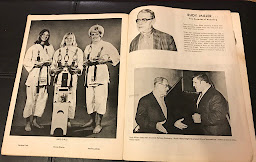
The Tri-State albums always featured bits on non-wrestlers, too, such as Pittsburgh broadcasting legend Bill "Chilly Billy" Cardille who was our voice of wrestling, promoters (including Vincent J. McMahon in one of the early books) and the man credited with discovering Bruno, Rudy Miller. This last installment also features a full page photo featuring three young women labeled "Judo Girls." Darlene Kalb, Donna Waxter and Jordie Ludwig were local judo champions who performed exhibitions during cards at the Civic Arena. I have no idea if the three are still with us, but adding their autographs to the book would certainly be fun as would hearing their stories from the era. 

While we always hear about WWF Magazine, pay-per-view event programs and other similar publications, very little is ever written about these great photo albums. I'm both thrilled and honored to document them for posterity. For more photos of this edition, including more of the autographs that I've filled this one with, follow us on Instagram @jws_wrestling_memorabilia. 

Thursday, July 31, 2014

The Territory Photo Albums--Pittsburgh 1967

 Fans nowadays have it easy!  If they want to know who's officially on the WWE roster, they can simply pull up the WWE App and a fully interactive listing is available at their disposal, complete with photos, facts, and even videos.  Back in the territorial days of wrestling, this would've been looked at as something out of science fiction.  The more advantageous fan might contact or even visit the offices of their local wrestling promoter in order to gain more info and facts, but that was about as far as it went.  If the fan wanted a "Who's Who" of wrestling stars and info they could usually purchase a program at an event, but one item was just a tad better: the photo album.

Most territories eventually released a publication billed as either a photo album or something similar.  These books were program/magazine sized and printed on a variety of materials.  Some had color, some did not.  Some had thicker, sturdier covers while others were all on standard paper.  A few were produced by the promotion itself, while others had some help from other publishers.  No matter the differences, they all served to advertise and promote the talent to the masses.

Since so many different albums were produced, it'd be an injustice to lump them all into one entry.  As a continuing series, we'll take a look at photo albums from territories around the country featuring many of the all-time greats and even some forgotten names.  For a few reasons, we'll start right here in the home city of this very blog, Pittsburgh, PA.

The photo albums put out by the Pittsburgh wrestling office, known as Spectator Sports, were titled "Tri-State Wrestling."  To many, they're known as the "Studio Wrestling photo albums," as "Studio Wrestling" was the name of the much-missed Pittsburgh wrestling television program, most famously hosted by Bill Cardille.  Growing up, I would constantly hear the WWF and other then-current wrestling promotions referred to as "Studio Wrestling" by adults.  I later figured out that the name is simply what these folks grew up on, so it became a generic title for which to refer to any form of pro wrestling.

Five of the Pittsburgh Tri-State Wrestling photo albums were produced in all, ranging from roughly 1963 to 1969.  The albums were sold through advertisements on arena programs and on the Studio Wrestling show itself.  For a nominal fee, you could own an album showing you full page shots of your local wrestling favorites, and even some national stars that were thrown in for good measure.  In the days before the over-saturation of televised wrestling, not to mention the Internet, these albums were the kind of thing that fans stared at for hours.

Exact release dates on these albums are fuzzy at best, but most agree that the edition shown here today is from around 1967 and would've been the third of the five released.  As with all but one of the Tri-State albums, the WWWF Champion Bruno Sammartino is featured in a classic pose on the cover.  These Tri-State covers were usually very colorful, and this one is a mix of color and glorious black and white.  Interestingly, Sammartino is referred to as the "Holder Of World-Wide Wrestling Federation Championship."  It is often recalled that the title was usually just referred to as the "World Championship" on Studio Wrestling broadcasts.

In addition to being fun to look at, these albums also often provided a great place to obtain autographs in those very early days of wrestling merchandising.  Subsequently, it is not unusual to purchase any territorial photo album that contain signatures.  Long time readers of this blog may remember this Tri-State album, as I once uncovered a photo of the late Chief White Owl autographing the cover of one.  Whether or not this is the exact one or not will never be known, but the one in my collection does indeed have White Owl's signature right on the cover.  I've since been able to add Sammartino's signature as well as other living Pittsburgh wrestling legends, but it's always interesting to see just who the original fan was able to meet up with all of those years ago.

The Tri-State albums are a mix of promotional style photos and action shots.  In addition to men who competed in the Pittsburgh and Western Pennsylvania area like Sammartino, George Steele, Gorilla Monsoon, Bill Miller, Johnny DeFazio, and The Battman are wrestlers who had either passed through the area at one time or may never have really spent any time here at all such as Bobo Brazil, Arman Hussain, Toru Tanaka, and Luke Graham.  It was a smart idea by the Pittsburgh promoters to make the promotion seem even larger and more important.

Another fun gimmick that the promoters used to make the promotion seem larger can be seen in several of the photos, most notably in the in-ring photo of Steele.  Though crowds at the WIIC (now WPXI) studios were boisterous, fake fans made of cardboard helped to fill out certain sides of the ring in an attempt to make the studio seem even larger.  In the days before high-definition television cameras, this most likely worked to a degree, despite being blatantly obvious here in print.

Speaking of the studio, it seems that the original owner of this album most likely attended a live television broadcast of Studio Wrestling.  The thought behind this is the inclusion of the two gem autographs of the album, the first of which is promoter Rudy Miller.  Miller is often credited with discovering Bruno Sammartino himself, and is in fact listed as such right here in the album.  Although he was probably accessible for an autograph, it likely didn't occur to many fans to ask him for one.  After all, he wasn't a wrestler.  Also shown on the page are various officials, the ring announcer, and Dr. Louis R. Civitarese.  Civitarese, who passed away in 2012 at the age of 92, was the doctor who attended to Sammartino when the legend broke his neck in the 1970's.

The other star autograph in the album is also of a man who was not a wrestler, but rather a baseball Hall of Famer.  Pie Traynor, legendary Pittsburgh Pirates third baseman, is best remembered in the city today for being the pitchman for American Heating Company.  Traynor would do live commercials during the Studio Wrestling program where he would proclaim "Who Can? AmeriCAN!" to a generation of steel town wrestling fans.  Today, mentioning either Traynor or Studio Wrestling to a Pittsburgher above the age of 55 will likely produce an imitation of the famous pitch.

I have a soft spot for Pittsburgh for many reasons that I've covered over the years, but looking through the photo album of any wrestling territory is a thrill.  They're yet another great relic of the wrestling business gone-by, but in some ways they're continuing today.  In upcoming editions of "The Territory Photo Albums," we'll take a look at all aspects of such publications, and I hope that the stars pop out of these entries the way that they do in these albums of ten, twenty, and even fifty years ago.

Sunday, August 21, 2011

Bruno! Bruno! Bruno!

I've been known to cover Bruno Sammartino and Pittsburgh wrestling fairly frequently here, but why not? For various reasons Pittsburgh is one of the least covered classic wrestling territories. The area had all of the in-ring action like the west coast and the unpredictable characters like the south. I'd also put the blue collar steel worker toughness up against that of the Texas roughneck stars any day. So why is Pittsburgh all but "forgotten?"

Unlike most of the territories that fell sometime in the 1980's, the true blue Pittsburgh wrestling office ceased to exist in the early 1970's for all intents and purposes. While lots of television and arena footage is still collected and traded of Charlotte, Florida, Minneapolis, and New York, the Pittsburgh action is only replayed in the memories of those who originally viewed it.

While the footage is lost to time, there are many still determined to keep the memories of Bruno and his friends and foes alive as long as there are fans of old school wrestling.

Earlier this summer I wrote of the many Studio Wrestling reunion appearances that have been made over the past couple of years in the Pittsburgh area. Large crowds have turned out for each one proving that Pittsburgh wrestling does have the lasting appeal of which I speak. Attending them myself, I've had the opportunity to have many of the classic Bruno and Pittsburgh relics autographed. While more items were produced than one would think, very few survive so many decades later. Fans who attend the events simply to meet their heroes are often astounded that these items still exist.

Bruno Sammartino himself was one of the earliest marketed stars in the industry. Dating back to his very first magazine cover in March of 1960, Bruno obviously equaled green at the newsstands. In his autobiography, a photo of Sammartino sitting with a group of magazines is captioned "I must have been on more magazine covers than Elvis!" Whether that is true or not, Bruno was certainly on more wrestling magazine covers than most of his contemporaries.

Wrestling World, Wrestling Revue, The Wrestling News, The Wrestler, and later Pro Wrestling Illustrated are just a few of the covers in which Bruno graced. The publishers of The Wrestling News even released several publications devoted solely to the Italian-born champion.

After his final departure from the WWF in 1988, Bruno merchandise continued to be in demand. A deal with Pittsburgh-based Imagine Inc. produced not only an autobiography of The Living Legend but also a Wrestling Legends trading card series with heavy imput from the champ. An in-depth look at this deal and the card series was the subject of a previous entry.

My personal favorite Bruno collectibles actually cover the entire spectrum of classic Pittsburgh wrestling. In the 1960's, a series of five photo albums entitled "Tri-State Wrestling" were released by the Pittsburgh wrestling office. The first dates to just before Bruno defeated Buddy Rogers for the WWWF Championship and is the only one not to feature Sammartino on the cover. Stars that made an impact on Pittsburgh such as The Battman, Gorilla Monsoon, George Steele, Johnny DeFazio, Lou Albano, and Toru Tanaka grace the inside pages as do stars such as The Kangaroos, Bobo Brazil, Edouard Carpentier, and Wahoo McDaniel who were known more for their work nationally.

The albums were advertised on the Studio Wrestling television show and viewers were encouraged to order them directly. While they do appear for auction occasionally, they are by no means easy to acquire. One collectors note is that it seems many fans would take these to both Studio Wrestling television tapings and to spot shows all around western Pennsylvania. Because of this it is not unusual to find these publications adorned with authentic autographs.

As I touched on above, publications such as the Tri-State albums, event programs, and photos are just about all that is left from such an action packed era. It is comforting to know that many of the era's stars and key players are also still with us to meet and share stories and memories from the glory years. For a fan such as myself who previously only had memories of family members of which to imagine the Pittsburgh wrestling dynasty, talking with these legends is both a treat and an honor.

As for the champ himself, Mr. Sammartino is still going strong at age 75. A recent heart valve replacement surgery wasn't enough to even slow Sammartino down. Just a few months later, The Living Legend was back greeting his fans at yet another Studio Wrestling reunion discussing the old days and a seemingly endless stream of new projects which we can all look forward to.

Memphis. Florida. Charlotte. Calgary. You were all great wrestling territories, but it's time to make a little room on the pedestal for another great hotbed--Pittsburgh.

Speaking of Pittsburgh, this very blog has been nominated in the "Everything Else" category in CBS Pittsburgh's "2011 Most Valuable Blogger Awards." By following this link, you can vote once a day! I appreciate each and every vote and thank you for voting and as always for reading!

Monday, June 6, 2011

The Steel City Still Reigns Supreme

When discussing wrestling history, cities such as New York, St. Louis, Dallas, Charlotte, and Tokyo immediately spring to mind. While there's no doubt that these were the top wrestling hotbeds, there is an underrated, overlooked, and often ignored city that deserves recognition. This is the Steel City, Pittsburgh, Pennsylvania.

It truly doesn't matter which era of wrestling you're most familiar with. From Bruno vs Steele to Mankind vs The Undertaker, Pittsburgh wrestling fans are full of squared circle memories. The hard working, blue collar fans in the Steel City simply resonate with each and every aspect of pro wrestling. The hard hitting action. The rough characters. The traditional struggle of good vs evil.

Sadly for fans under the age of about 45, many of Pittsburgh's greatest wrestling moments are lost to history. The legendary Studio Wrestling program that starred Bruno Sammartino, Dominic DeNucci, The Crusher, The Battman, Waldo Von Erich, George Steele, announcer Bill Cardille and so many, many more is all but gone. WIIC-TV (now WPXI) , like many early television entities, taped over the weekly shows. Programs, magazines, photos, and even a few sound bytes are all that is left to keep the memories alive.

Another way that the Pittsburgh wrestling legacy has been kept alive is from a series of Studio Wrestling reunion appearances held in the area over the past two years. Sammartino, Steele, Johnny DeFazio, Ivan Koloff, and Baron Mikel Scicluna (in his final appearance) are just several of the names to attend these events. The appearance of children at these shows is proof that longtime Pittsburghers are sharing their longtime love for the sport of kings.

As touching as it is to see fans, young and old, meeting their local heroes, it is equally as compelling to witness the wrestling legends themselves in the spotlight once again. Even men such as Sammartino, Koloff, and Steele who attend such shows around the country are obviously affected by the outpouring of admiration in Pittsburgh. Hearing their stories, often elicited before the events by Bill Cardille, only reinforces the rich history of the region. Many fans, such as myself, get extra stories out of the stars when presenting classic items for them to autograph. It is these tales and memories, not the autographs or items, that are the true irreplaceable antiquities.

Sadly, it seems that one of the biggest icons of the city is on life support. As I discussed about a year ago, the Pittsburgh Civic Arena seems to be just months away from meeting the wrecking ball. A truly unique structure, the "Igloo" was home not only to so many of Sammartino's legendary battles, but also two of Pittsburgh native Kurt Angle's championship wins as well as the infamous Mankind-Undertaker Hell in the Cell match. It was also the place where, in 1992, a 9-year-old kid witnessed his first ever live pro wrestling card that just happened to involve Hulk Hogan, Roddy Piper, and Ric Flair.

Even government "progress" can't diminish the impact pro wrestling has had on the former "smoky" city. It's a shame that someone has not chronicled Pittsburgh's amazing wrestling story for posterity. Whether or not that ever happens, Pittsburghers themselves know that they live in one of the world's great wrestling cities. Perhaps the very last "best kept secret" the sport will ever know.

**********"From The Musty, Yellowed Pages..."**********

Wrestling World, April 1968, Page 50

Keeping with the legacy of Pittsburgh wrestling, I present a personal collectible story involving one of Studio Wrestling's late stars.

Chief White Owl was one of the many names that frequently competed in the Pittsburgh/Cleveland area. A fan-friendly wrestler, the Chief was known to be accessible for autographs. This is proven with the fact that over the past year I've acquired two of the Chief's autographs that were signed in the 1960's. Several magazines even show the Chief signing for groups of fans. One of those is this particular issue of Wrestling World.

This issue contains a multi-page article on the Chief and the various locales in which he was wrestling at the time. The photos for the article were taken at a Studio Wrestling taping. Upon reading the article, I noticed the Chief about to sign a Tri-State Wrestling publication. The Tri-State books are among my favorite wrestling collectibles of all-time. A total of five were produced by the Pittsburgh wrestling office in the 1960s and each contains a virtual time capsule of wrestling in Pittsburgh and the Bruno Sammartino dynasty. Although rarely found, issues will often include signatures obtained by the original owner. My own copy of the particular issue that Chief White Owl is about to sign in the photo...has Chief White Owl's signature on the cover.

In a bit of detective work in the style often left to devotees of the Kennedy assassination or UFO researchers, I enlarged and rotated the photo of White Owl about to sign the magazine and inset a photo of my own copy. The astute fan can see the small photos of Bruno performing various wrestling moves on the cover of the magazine. Is White Owl about to sign my exact copy? We'll never know. White Owl signed plenty of autographs and many fans used these Tri-State magazines for that exact purpose. Just like those who insist that someone is lurking in the grassy knoll...I believe in the photographs!