Maybe this list should've been saved for Halloween! Who else loved the bloody wrestling magazine covers of yesteryear? I can't imagine many saying that they didn't. These covers are almost a foreign concept in a world where wrestling matches are stopped when a drop of blood comes trickling out. It's a different time, and not necessarily a better one. Thankfully, we have these artifacts to look back on, showcasing the gory, wild west world of vintage professional wrestling.
The stars of the '70s were wild in and out of the ring. Two of the most notorious were Harley Race, who could fill a bloody cover story all by himself, and the late Blackjack Mulligan. In March 1979, the two were seen in a gruesome bloodbath on the cover of Inside Wrestling. Mulligan's infamous clawhold seems to be actually causing the blood to squirt from the head of Race...
Speaking of wild, how about Buddy Colt? This top talent in such areas as Florida and Georgia may not be a common name to today's fans, but students of the past are more than familiar with the grappler. In fact, it's the very photo used on the cover of a 1974 Wrestling Yearbook issue that shows up time and again when Colt comes into the conversation. The caption? "Buddy Colt Loves Blood - Even If It's His." Well then...
Speaking of loving their own blood, you get a feeling that "The Brain" may have been the same way. There are tons of magazine covers featuring Bobby Heenan's mug covered in a "crimson mask," but none are more iconic than the November 1970 issue of The Wrestler. The magazine had it's own feature on this blog at one point, and Heenan still lights up when he sees this particular cover.
One of Heenan's most connected protege's also shed blood on occasion, that being Nick Bockwinkel. On a 1980 Wrestling Annual magazine, the erudite champion is seen on the cover after a brutal AWA Championship defense. His famous belt barely held up, the dazed Bockwinkel likely just had the fight of his life.
Of course, bloody covers can come in the form of programs, too. Each territory had their programs, but few may have been cooler than those from Memphis. The September 26, 1979 program cover features a very young Terry "Bam Bam" Gordy covered in a mass of blood. The photo may be black and white, but that does not stop the intensity of the moment from coming through.
A small sampling? Yes, but some of the best. The blood is often missed from today's product, but looking at these images certainly keeps the gruesome past alive. Bloody Hell!
Showing posts with label Inside Wrestling. Show all posts
Thursday, August 24, 2017
Thursday, December 8, 2016
The Dragon Scorches The Cover
Many consider him to be one of the greatest of all-time. Others say they've seen none better. Without a doubt, you were highly entertained if you've ever viewed a Ricky Steamboat match. "The Dragon" could do it all, with just about any opponent, and never gave less than 100%. The man had a tremendous look, as well. Exotic and dangerous, he was the wrestler that guys wanted to be and that girls wanted to be with, yet he remained a wholesome hero of the squared circle.
During his career, Steamboat's image graced the cover of many publications. The grappler who would later call North Caroline his home actually first began setting the world on fire in the late '70s as part of Jim Crockett Promotions and Mid-Atlantic Championship Wrestling. With longer hair than he would later be known for, Steamboat was played up as a Hawaiian high-flyer who did things that many other stars of the time did not. Though he had many top-level feuds at the time, his bouts with "Nature Boy" Ric Flair would be a prelude to their storied NWA World Championship rivalry a decade later. Many have said that these Mid-Atlantic matches, mostly confined to the memories of fans in the arena live, were even better than those later seen on a national level.
The treasured Mid-Atlantic Championship Magazines saw a few Steamboat covers, but none are cooler than the "beach" cover of Issue No. 3 Vol. 8. These magazines are quite collectible and always fetch a high price when they appear for sale these days. Many of the early covers feature beautiful artistic renderings of the promotions stars. Steamboat in his "native" lands of Hawaii is definitely unique and almost too peaceful for a wrestling magazine.
As Pro Wrestling Illustrated was instituted in 1979, it's no surprise that the publication grew as did the career of "The Dragon." Ricky made several PWI covers over the years, including one in May 1981 that featured him as Mid-Atlantic Wrestling Heavyweight Champion. The title belt, a favorite of many classic wrestling fans, saw one of its greatest national showcases on this cover. Steamboat also throws the old adage that "babyfaces don't grow facial hair" out the window as the cover shows him sporting quite the mustache.
By the middle of the decade, Ricky Steamboat had transformed into a
master of the martial arts somewhat reminiscent of Bruce Lee. "The Dragon" was born in the WWF and would be a moniker that followed Steamboat through the rest of his career. Steamboat saw his sole WWF Magazine cover appearance on the October/November 1985 issue. A striking and dramatic cover, the issue seems to show up much less than other issues of the time and, thus, commands a higher price when it does appear for sale.
Many fans consider the WrestleMania III encounter between Steamboat and Randy "Macho Man" Savage as their all-time favorite match. The bout ended with "The Dragon" as the Intercontinental Champion. Though his title reign was notoriously short, Steamboat made the ideal holder of that particular title. After all, it's often said that the matches for that championship "stole the show," just as Steamboat did more often than not. A 1987 WWF program cover appearance shows Steamboat during his brief reign, holding the Intercontinental Title high in the air. Iconic and historic.
Although he just misses my own "Five All-Time Favorite Wrestlers" list, he's definitely in the next five. When a Steamboat match is on, you watch. You can't help but watch. Meeting him many times over the years, Steamboat's greatness in the ring is only matched by his real-life attitude towards his many fans. If anyone ever came away from a meeting with "The Dragon" with any less than a smile on their face, I'd be truly shocked. The phrase "Never meet you heroes" does not apply here.
A true champion of life, cover-to-cover.
During his career, Steamboat's image graced the cover of many publications. The grappler who would later call North Caroline his home actually first began setting the world on fire in the late '70s as part of Jim Crockett Promotions and Mid-Atlantic Championship Wrestling. With longer hair than he would later be known for, Steamboat was played up as a Hawaiian high-flyer who did things that many other stars of the time did not. Though he had many top-level feuds at the time, his bouts with "Nature Boy" Ric Flair would be a prelude to their storied NWA World Championship rivalry a decade later. Many have said that these Mid-Atlantic matches, mostly confined to the memories of fans in the arena live, were even better than those later seen on a national level.The treasured Mid-Atlantic Championship Magazines saw a few Steamboat covers, but none are cooler than the "beach" cover of Issue No. 3 Vol. 8. These magazines are quite collectible and always fetch a high price when they appear for sale these days. Many of the early covers feature beautiful artistic renderings of the promotions stars. Steamboat in his "native" lands of Hawaii is definitely unique and almost too peaceful for a wrestling magazine.
As Pro Wrestling Illustrated was instituted in 1979, it's no surprise that the publication grew as did the career of "The Dragon." Ricky made several PWI covers over the years, including one in May 1981 that featured him as Mid-Atlantic Wrestling Heavyweight Champion. The title belt, a favorite of many classic wrestling fans, saw one of its greatest national showcases on this cover. Steamboat also throws the old adage that "babyfaces don't grow facial hair" out the window as the cover shows him sporting quite the mustache.
By the middle of the decade, Ricky Steamboat had transformed into a master of the martial arts somewhat reminiscent of Bruce Lee. "The Dragon" was born in the WWF and would be a moniker that followed Steamboat through the rest of his career. Steamboat saw his sole WWF Magazine cover appearance on the October/November 1985 issue. A striking and dramatic cover, the issue seems to show up much less than other issues of the time and, thus, commands a higher price when it does appear for sale.
Many fans consider the WrestleMania III encounter between Steamboat and Randy "Macho Man" Savage as their all-time favorite match. The bout ended with "The Dragon" as the Intercontinental Champion. Though his title reign was notoriously short, Steamboat made the ideal holder of that particular title. After all, it's often said that the matches for that championship "stole the show," just as Steamboat did more often than not. A 1987 WWF program cover appearance shows Steamboat during his brief reign, holding the Intercontinental Title high in the air. Iconic and historic.
Although he just misses my own "Five All-Time Favorite Wrestlers" list, he's definitely in the next five. When a Steamboat match is on, you watch. You can't help but watch. Meeting him many times over the years, Steamboat's greatness in the ring is only matched by his real-life attitude towards his many fans. If anyone ever came away from a meeting with "The Dragon" with any less than a smile on their face, I'd be truly shocked. The phrase "Never meet you heroes" does not apply here.A true champion of life, cover-to-cover.
Thursday, July 21, 2016
Totally '80s! Wrestling Merchandise Magazine Ads
It was the golden age of merchandising in professional wrestling! Gone were the days where you had to attend an actual wrestling event to snap up whatever items you could get your hands on. Photos, programs, and the occasional bumper sticker or pennant were great, but now the world had action figures, watches, videotapes, and even record albums! Best of all, you could order them straight from the pages of your favorite wrestling magazine. A decade earlier, kids were sneaking peeks of stuff that "older brother" or "creepy, lonely neighbor" were ordering from these same publications. By 1989, the younger market was being completely taken care of with (usually) age-appropriate items from various wrestling companies.
The ads that you're about to see all emanate from the pages of the February 1989 issue of Inside Wrestling, featuring a great cover shot of the newly-christened Brainbusters--Tully Blanchard and Arn Anderson. I'm not including this as an edition of our "From The Musty Yellowed Pages" series, as we aren't really looking into the magazine but rather just the ads. Most of these ads can be found in multiple magazines of the time, but this seemed like a good issue to look at with a wide variety of merchandise spanning several promotions.
Right inside of the front cover are two fantastic ads. The first is one of two ads in the issue from "The Wrestling Ring" company which was based out of Baltimore, MD. A search on any Internet wrestling forum will likely yield at least a couple of nostalgic stories from fans who ordered from "The Wrestling Ring." No longer in business, the mail-order company seemed to have capitalized on the time of the "Rock N Wrestling" era. This ad focuses on WWF digital watches. You can choose from Hulk Hogan, Randy Savage, Miss Elizabeth, Jake "The Snake" Roberts, Koko B. Ware, and Ricky "The Dragon" Steamboat, who was already gone from the WWF. Also in this ad are two early NWA foam belts which are relatively in demand these days. Note the wrestling ring that the fist is "bursting" through is fashioned using posts and turnbuckles from the LJN WWF ring.
On the first actual page of the issue is an ad for "A Von Erich Extravaganza!" This ad is direct from the publishing
company itself which must have had an overstock of the Von Erich's
"Front Row Ringside" VHS video and "A Family Album" book. The album
itself has been featured before on this very blog, and the "Front Row
Ringside" video can be viewed as of press time on a very popular online
video site. The original video as well as the book both prove to still be popular whenever the show up on the market today.
The Weston or Apter Mags were never shy about ads for back issues of their various publications. Here we see that for a time the company was even bundling back issues together focusing on one particular superstar. This time we get "A Special Offer For All 'Hulkamaniacs'" featuring ten different cover stories of Hulk Hogan. Pictured is a somewhat husky young Hulkamaniac, decked out in a 1985ish "Hulkster" headband, Pro Wrestling Illustrated t-shirt, and one of the aforementioned foam NWA Championship belts. He's representing '80s rasslin' to the max. Just $19.95 got you all ten issues. In 2016, the smart wrestling collector could obtain those same ten issues for just about the same price with enough searching.The full-color back page features one of the best remembered ads of the era, again from "The Wrestling Ring" company. This ad features many of the LJN WWF Wrestling Superstars figures that had been released up to that point. Also shown are the large figure of Rowdy Roddy Piper and the wrestling ring and cage also all from LJN. We even get yet another cameo by one of those foam NWA Championship belts. It's great to see the LJNs in all of their glory. The colors of the figures look particularly rich in the main photo, too. As 1989 progressed an even more famous ad was run in these magazines by "The Wrestling Ring." That ad featured mentions (but NOT pictures) of some of the unreleased figures such as The Barbarian, Demolition Smash, and Bad News Brown.
What a collection of '80s gems! It all goes back to the old saying "If I only knew then what I know now..." That, of course, gives way to another phrase, "Hindsight is 20/20." Nevertheless, even if we don't own all of these great items, we still have these great advertisements to look back on. Perhaps one day we'll take a look at some wrestling magazine ads from even earlier decades. Then again, maybe not. After all, I prefer to keep this blog "family friendly."
Thursday, October 2, 2014
The Wonderful (& Forgotten) World of Bobby Shane
From this point forward, nearly every wrestler who has even a fleeting brush with success will have their career highly documented. Their matches, even at an indy level, will be recorded by someone and kept whether the wrestler has a career of two months or twenty years. Forty years ago, that was not the case at all. Unless your matches were filmed at the arena or you wrestled in an area that miraculously didn't tape over or destroy their tapes, your work could largely be lost to history. Such is the case of Bobby Shane.
Thankfully, wrestling has quite the number of followers who enjoy documenting history. Many undercard or journeyman wrestlers would be completely forgotten without these folks. It wasn't that their in-ring work was sub-par, it was just that due to their positioning on the card, these wrestlers didn't get the press and fame that the larger stars did. Bobby Shane is a relatively unknown name to fans my age and younger, but not for these reasons. Instead, Shane was struck down just as his career began to rise.
There are many great biographies of Shane available on the net by those who've studied him. My intentions are to instead familiarize those who, like myself, knew the name from two particular instances that are often retold, as well as various magazine covers and stories. Like so many of us, Shane grew up as a fan of pro wrestling. He got his foot in the door of the business like others in that era, doing odd jobs for the local wrestling promotion, St. Louis in his case.
Shane fulfilled his dream of becoming a pro wrestler, and wrestled through much of the 1960's as "Wonder Boy" Bobby Shane. Accounts say that Shane was a popular babyface, but much of the reverence for the young grappler comes from his run as "The King of Wrestling" that he adopted in roughly the last five or so years of his career. Sadly, there is little footage of Shane remaining. Although a clip of the end of a match pitting Shane against Jack Brisco is currently available and old discussions seem to indicate that a bit more exist, Shane is mostly lost to time.
Still, an interested fan that does research on Shane will see a wrestler that could probably even fit into the scene today, were he born twenty years ago. His charisma comes through with the many still photos of him, especially in his "King of Wrestling" stint. A 1972 issue of Wrestling Monthly proclaims Shane to be one of the top five most hated wrestlers, along with the likes of Dusty Rhodes, Ivan Koloff, The Sheik, and Pampero Firpo. That's quite the "evil" company right there. His promos were said to be very good and had the tone of a spoiled brat always wanting to get his own way. One can only wonder if he'd have eventually became another great manager in the era of Bobby Heenan, Jim Cornette, and Jimmy Hart. He was also said to have had a great mind for the creative end of the business, and began to work in that capacity at the time of his death.
The two tales that you may remember regarding Shane are from the end of his life. A young wrestler named Jerry Lawler approached Shane to inquire about how he could obtain similar "King" attire. Shane provided Lawler with the name of the company that he ordered his garb from. Since Shane was shortly thereafter going on a tour of Australia where he would not be using the gimmick, he lent Lawler his crown. Shane returned from that trip and began wrestling in Florida, but never did retrieve the crown from Lawler. On a February night in 1975, Shane boarded a small plane piloted by top wrestler Buddy Colt. Gary Hart and Mike McCord, later to be known as Austin Idol, were also aboard. Bad conditions contributed to the plane never reaching its intended destination. Although Colt, Hart, and McCord suffered horrible injuries, Shane did not survive. He was 29 years old.
While he'll never have an action figure or appear in a video game, Shane memorabilia does exist. He and fellow wrestler Gerry Monti had a fan club sometime in the '60s which featured some well-produced publications. An exotic-looking color post card is another Shane item that features probably his most often seen pre-King image. It was that "royal" look that saw Shane appear on many magazine covers, often with his valet and then-wife Miss Sherri. The mustache and colorful attire that he wore may date the images, but actually shows Shane in an "old school cool" air that keeps him timeless.
It isn't likely that WWE is going to teach their universe about Bobby Shane any time soon. It's up to fans who truly want to learn about the lost past of the business. Men and women who have every right to be remembered just as well as the names that are, but who are forgotten for whatever reason. They're unsung heroes who, had life played just a bit differently, might be looking back fondly on the fruits of their labor today. By learning and remembering, we can help make up for it.
Thankfully, wrestling has quite the number of followers who enjoy documenting history. Many undercard or journeyman wrestlers would be completely forgotten without these folks. It wasn't that their in-ring work was sub-par, it was just that due to their positioning on the card, these wrestlers didn't get the press and fame that the larger stars did. Bobby Shane is a relatively unknown name to fans my age and younger, but not for these reasons. Instead, Shane was struck down just as his career began to rise.
There are many great biographies of Shane available on the net by those who've studied him. My intentions are to instead familiarize those who, like myself, knew the name from two particular instances that are often retold, as well as various magazine covers and stories. Like so many of us, Shane grew up as a fan of pro wrestling. He got his foot in the door of the business like others in that era, doing odd jobs for the local wrestling promotion, St. Louis in his case.
Shane fulfilled his dream of becoming a pro wrestler, and wrestled through much of the 1960's as "Wonder Boy" Bobby Shane. Accounts say that Shane was a popular babyface, but much of the reverence for the young grappler comes from his run as "The King of Wrestling" that he adopted in roughly the last five or so years of his career. Sadly, there is little footage of Shane remaining. Although a clip of the end of a match pitting Shane against Jack Brisco is currently available and old discussions seem to indicate that a bit more exist, Shane is mostly lost to time.Still, an interested fan that does research on Shane will see a wrestler that could probably even fit into the scene today, were he born twenty years ago. His charisma comes through with the many still photos of him, especially in his "King of Wrestling" stint. A 1972 issue of Wrestling Monthly proclaims Shane to be one of the top five most hated wrestlers, along with the likes of Dusty Rhodes, Ivan Koloff, The Sheik, and Pampero Firpo. That's quite the "evil" company right there. His promos were said to be very good and had the tone of a spoiled brat always wanting to get his own way. One can only wonder if he'd have eventually became another great manager in the era of Bobby Heenan, Jim Cornette, and Jimmy Hart. He was also said to have had a great mind for the creative end of the business, and began to work in that capacity at the time of his death.
The two tales that you may remember regarding Shane are from the end of his life. A young wrestler named Jerry Lawler approached Shane to inquire about how he could obtain similar "King" attire. Shane provided Lawler with the name of the company that he ordered his garb from. Since Shane was shortly thereafter going on a tour of Australia where he would not be using the gimmick, he lent Lawler his crown. Shane returned from that trip and began wrestling in Florida, but never did retrieve the crown from Lawler. On a February night in 1975, Shane boarded a small plane piloted by top wrestler Buddy Colt. Gary Hart and Mike McCord, later to be known as Austin Idol, were also aboard. Bad conditions contributed to the plane never reaching its intended destination. Although Colt, Hart, and McCord suffered horrible injuries, Shane did not survive. He was 29 years old.While he'll never have an action figure or appear in a video game, Shane memorabilia does exist. He and fellow wrestler Gerry Monti had a fan club sometime in the '60s which featured some well-produced publications. An exotic-looking color post card is another Shane item that features probably his most often seen pre-King image. It was that "royal" look that saw Shane appear on many magazine covers, often with his valet and then-wife Miss Sherri. The mustache and colorful attire that he wore may date the images, but actually shows Shane in an "old school cool" air that keeps him timeless.
It isn't likely that WWE is going to teach their universe about Bobby Shane any time soon. It's up to fans who truly want to learn about the lost past of the business. Men and women who have every right to be remembered just as well as the names that are, but who are forgotten for whatever reason. They're unsung heroes who, had life played just a bit differently, might be looking back fondly on the fruits of their labor today. By learning and remembering, we can help make up for it.
Labels:
Autographs,
Bobby Shane,
Inside Wrestling,
Magazine,
Wrestling Monthly
Thursday, September 26, 2013
Mil Mascaras: Masked Man of Merchandising
Seeing as that this is the Wrestling Memorabilia Blog, we often pay tribute to pioneers in wrestling merchandising. Awhile back, we took a look at efforts in the Memphis wrestling promotion that included the birth of "the gimmick table" and many other merchandising concepts. This time around our spotlight is on an individual star. From his look to his charisma, both of which were shrouded in mystique, it's no wonder why the man became one of the first big merchandising stars of the wrestling business. That man is Mil Mascaras.
The Man of 1,000 Masks is said to have begun his career simultaneously as a Mexican movie star and luchador. With that being the case, one could argue that his merchandising began as soon as his career did. With his colorful masks and costumes plastered on movie posters and lobby cards, the Mexican public was already becoming enamored with the man formerly known as Aaron Rodriguez. Though this took place in the mid-1960's, it was the following decade when Mascaras became a true worldwide name in wrestling.
All Japan Pro Wrestling regular featured Mascaras in the 1970's which propelled the Mexican star to a top spot in Japan. It was here that he adopted a theme song. "Sky High" by British group Jigsaw became the associated tune of the high flying star. Photos of the luchador appeared on various releases of the song. A disco anthem to be sure, the song is very catchy and has several portions that absolutely fit a '70s hero. Mascaras still uses this song today for matches around the world.
Domestically, Mascaras became best known in the '70s for his work in the IWA and the WWWF. It was in the latter promotion that wrestling magazine editor and photographer Bill Apter shot so many iconic photos of the masked star. For decades now, Apter has deemed Mascaras as his favorite wrestler and can be seen at ringside for many of the masked star's matches in old Madison Square Garden films. It's no coincidence that in 1979, Apter chose Mascaras along with Dusty Rhodes to star on the cover of the first issue of Pro Wrestling Illustrated.
The premiere of PWI was hardly Mascaras' introduction to the American wrestling magazine. From Inside Wrestling and The Wrestler to Wrestling Revue and Wrestling Monthly, Mascaras appeared on the cover of every title available on the newsstand that decade. Is it any wonder? An exotic and mysterious high-flying masked man with colorful outfits and maneuvers to boot? A real life superhero come to life in wrestling rings across the world. Next to faces covered with the proverbial "crimson mask," Mascaras was probably the most frequent subject of wrestling magazine covers of the decade.
In 1983, Mascaras along with Bernie Lopez Enterprises released "Mil Mascaras Pro Wrestling Game." The board game is a complicated early wrestling "simulator" that can even be played solo. Using dice, numbers, and many, many rules, players can "promote matches in the wrestling capitals of the world--New York, Tokyo, Mexico City, Hong Kong, etc." according to the box. The game is certainly an interesting novelty, probably the first of its kind, and features two box photos credited to wrestling's other top photographer, George Napolitano.
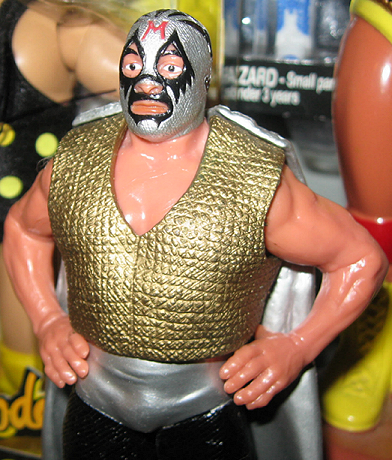
Surprisingly, it was not until the last decade that quality action figures of Mil Mascaras appeared on the market. For years, unlicensed figures were produced in Mexico and sold by street vendors to children yearning to recreate the matches of their national hero. In the early 2000's, licensed Mil Mascaras figures in a variety of outfits were produced by Character Product in Japan. The masked man's popularity has not waned in the Land of the Rising Sun, and these figures are proof positive. A nearly perfect likeness along with removable accessories combine to bring us what will likely be the nicest Mil Mascaras figures ever produced. Despite being a perfect candidate for one of the wide variety of wrestlers in the line, Mascaras was never part of the Jakks WWE Classic Superstars line.
Mascaras is just one third of a trio of brothers who became stars of lucha libre. Dos Caras and Sicodelico (who in my opinion had the coolest mask of the three) also ruled rings around the world, although never with quite the amount of fame as Mascaras. In 2012, Mascaras was inducted into the WWE Hall of Fame by his nephew, Alberto Del Rio, the son of Dos Caras.
Despite criticisms of his behavior both in and out of the ring, I've always been mystified by Mascaras. A little over a year ago, I had the chance to see the masked legend perform live. Still flashy, still charismatic, and still giving nothing to his opponent, Mascaras turned back the clock for about five minutes. Say what you want about the man, he is an originator. Whereas before you may have thought it was simply because he was the Man of 1,000 Masks, he may also be the original Man of 1,000 Gimmicks!
The Man of 1,000 Masks is said to have begun his career simultaneously as a Mexican movie star and luchador. With that being the case, one could argue that his merchandising began as soon as his career did. With his colorful masks and costumes plastered on movie posters and lobby cards, the Mexican public was already becoming enamored with the man formerly known as Aaron Rodriguez. Though this took place in the mid-1960's, it was the following decade when Mascaras became a true worldwide name in wrestling.All Japan Pro Wrestling regular featured Mascaras in the 1970's which propelled the Mexican star to a top spot in Japan. It was here that he adopted a theme song. "Sky High" by British group Jigsaw became the associated tune of the high flying star. Photos of the luchador appeared on various releases of the song. A disco anthem to be sure, the song is very catchy and has several portions that absolutely fit a '70s hero. Mascaras still uses this song today for matches around the world.
Domestically, Mascaras became best known in the '70s for his work in the IWA and the WWWF. It was in the latter promotion that wrestling magazine editor and photographer Bill Apter shot so many iconic photos of the masked star. For decades now, Apter has deemed Mascaras as his favorite wrestler and can be seen at ringside for many of the masked star's matches in old Madison Square Garden films. It's no coincidence that in 1979, Apter chose Mascaras along with Dusty Rhodes to star on the cover of the first issue of Pro Wrestling Illustrated.The premiere of PWI was hardly Mascaras' introduction to the American wrestling magazine. From Inside Wrestling and The Wrestler to Wrestling Revue and Wrestling Monthly, Mascaras appeared on the cover of every title available on the newsstand that decade. Is it any wonder? An exotic and mysterious high-flying masked man with colorful outfits and maneuvers to boot? A real life superhero come to life in wrestling rings across the world. Next to faces covered with the proverbial "crimson mask," Mascaras was probably the most frequent subject of wrestling magazine covers of the decade.
In 1983, Mascaras along with Bernie Lopez Enterprises released "Mil Mascaras Pro Wrestling Game." The board game is a complicated early wrestling "simulator" that can even be played solo. Using dice, numbers, and many, many rules, players can "promote matches in the wrestling capitals of the world--New York, Tokyo, Mexico City, Hong Kong, etc." according to the box. The game is certainly an interesting novelty, probably the first of its kind, and features two box photos credited to wrestling's other top photographer, George Napolitano.Surprisingly, it was not until the last decade that quality action figures of Mil Mascaras appeared on the market. For years, unlicensed figures were produced in Mexico and sold by street vendors to children yearning to recreate the matches of their national hero. In the early 2000's, licensed Mil Mascaras figures in a variety of outfits were produced by Character Product in Japan. The masked man's popularity has not waned in the Land of the Rising Sun, and these figures are proof positive. A nearly perfect likeness along with removable accessories combine to bring us what will likely be the nicest Mil Mascaras figures ever produced. Despite being a perfect candidate for one of the wide variety of wrestlers in the line, Mascaras was never part of the Jakks WWE Classic Superstars line.
Mascaras is just one third of a trio of brothers who became stars of lucha libre. Dos Caras and Sicodelico (who in my opinion had the coolest mask of the three) also ruled rings around the world, although never with quite the amount of fame as Mascaras. In 2012, Mascaras was inducted into the WWE Hall of Fame by his nephew, Alberto Del Rio, the son of Dos Caras. Despite criticisms of his behavior both in and out of the ring, I've always been mystified by Mascaras. A little over a year ago, I had the chance to see the masked legend perform live. Still flashy, still charismatic, and still giving nothing to his opponent, Mascaras turned back the clock for about five minutes. Say what you want about the man, he is an originator. Whereas before you may have thought it was simply because he was the Man of 1,000 Masks, he may also be the original Man of 1,000 Gimmicks!
Thursday, December 20, 2012
The 2012 J\/\/ Awards
It feels like only yesterday that I was writing about the 2011 J\/\/ Awards. A fun way to end the calendar year, the awards are chosen by a strict committee--myself. The same committee also decides the look of the "Joshie" award which has changed each year since its inception. While the coveted trophy has appeared "classy" and "immortal" in the past, this year the committee decided to get the "attention" of you "maggots," but I'd really like you to be "at ease" while taking in all of the awards.With all of the cliches aside, it's time to get to the awards themselves. Although tweaked after the first year, I think that the five categories are now firmly established and shall be for years to come. A few surprises? A few upsets? A little bit of bias? Of course! That's why they're the J\/\/ Awards!
2012 Best Figure
The most controversial J\/\/ Award is always Best Figure. Although the list of companies from which the figures are licensed is shorter than ever, the quality of product is still very high. Uniqueness is as big of a deciding factor here as design.
Mattel's WWE Elite Jerry "The King" Lawler wins "The Joshie" for 2012 Best Figure. Seeing as that I was not a fan of the initial prototype pictures, this could be considered somewhat of an upset. The figure, just released in the past several weeks, is a perfect blend of design. The figure captures "The King" in his WrestleMania XXVII attire, a look that already blended the Lawler of yesterday and today. This is the first Mattel representation of Lawler and is part of their Elite line which comes packaged in a very attractive "window" box. Add it all up and you can only come to one verdict: "Long Live The King!"
2012 Best Publication
A lot can fall into this category. Books. Magazines. Pamphlets (yes, Tito Santana, I'm looking at you). If it's printed material about wrestling, it's up for consideration.
Inside Wrestling/The Wrestler Magazine wins "The Joshie" for 2012 Best Publication. The award becomes more of a "Lifetime Achievement" this year as 2012 is sadly the final full year for the publication. Beginning as individual titles more than forty years ago, countless fans grew up quenching their thirst for the sport of wrestling through these magazines. Bloody covers, top ten ratings, and several generations of professional wrestlers made these titles unforgettable for almost six decades.
2012 Best Buy (Non-Figure/Publication)
What in the world of wrestling gave fans the most bang for their buck? In 2012 that buck had to be stretched further than ever. The best result from that is what we're looking at here.
The 2012 TNA Lockdown Fanfest wins "The Joshie" for 2012 Best Buy. Autographs and photo ops from dozens of Impact Wrestling's greatest, not to mention the two biggest names in wrestling history, all for around $200? Sold. Hogan. Flair. Angle. Hardy. RVD. Roode. Storm. Bully Ray. Devon. I could go on. TNA truly knows how to put on a "Meet & Greet." For those of you familiar with the world of fanfests and conventions, you know that the value is phenomenal. The only competitor for this year's award would've been a 2012 version of Greg Price's annual Legends Fanfest. Sadly, this year's version was canceled, but I'm sure the 2013 edition in Charlotte will make next year's running.
2012 Best Product Line
Anything that has continual releases throughout the year can be considered here. That being said, I can see the most repeat wins taking place in this category in the future.
Mattel wins "The Joshie" for 2012 Best Product Line. This perhaps could be the biggest surprise for frequent readers as I'm often very critical of Mattel's handling of the WWE license. Not everything that they do pleases me, although it isn't always their fault. Other issues such as distribution most certainly are. When looking at 2012 as a whole, Mattel has put out some pretty impressive product. From creating a very appealing new package design template that was rolled out line-wide to some fun and unique exclusives such as Build-A-Figure, the Mattel/WWE tag team had a helluva year. Seeing some of the product that will be hitting in the first quarter of next year, Mattel may capture yet another "Joshie" to match their 2010 and 2012 wins.
2012 Future Holy Grail
This is the item or line that people will be enjoying for years to come. Wrestling memorabilia from this year that will stand the test of time...
Topps WWE Heritage 2012 Trading Cards win "The Joshie" for 2012 Future Holy Grail. I've been talking about this set for months and when it finally hit my hands, I was more than impressed. Nearly everything here blew me away, and I'm not the only collector who felt that way. I've already put together several base sets and yet I still find myself tempted to pick up more packs for subsets and hits. I'm addicted, and I think that feeling will carry on for years over this set. I will admit that this is one "Holy Grail" award that I'd like to be proven wrong about. If Topps can come up with another Heritage set in the future that would top this, I'm all for it.
The envelopes are open. The world now knows just what the gold in wrestling memorabilia was for 2012. Agree? Disagree? "Like" our Facebook Fanpage and send some feedback! You can also see every J\/\/ Award winner from each year in a special gallery!
It's been a fast paced and fun year. Thank you all for reading, enjoying, and maybe even learning over the past twelve months. We'll be back next week for the final entry of the year, but until then...
Thursday, November 22, 2012
A Bit More Wrestling Tradition Slips Away...
When news broke of two legendary wrestling magazines, Inside Wrestling and The Wrestler, being discontinued, I was saddened but not shocked. The world of print media has been jumping to digital form for a number of years now. It was a testament to both the editorial force behind the magazines as well as their loyal readers that the titles remained as long as they did.
I can't count the times I've seen and heard fans recall their first look at a classic issue of one of these titles. One look at a cover like the November 1970 issue of The Wrestler could cause it to be a seared into a fan's brain forever, regardless of age! The cover, featuring an intensely bloody Bobby Heenan, was a great example of the old wrestling adage that "red equals green." The crimson mask shown on "The Brain" certainly made the issue one of the favorites of fans worldwide.
The violent side of wrestling wasn't the only type of memorable cover. Many times it was a case of grandeur. When a cover featured a champion boastfully holding or wearing their championship belt, that proud feeling could transfer right over to the fan buying the issue. No matter the snide looks of the convenience store clerk condescendingly grabbing your money, you were purchasing a magazine that featured the best in the squared circle. A championship belt wasn't always even necessary, such as when the cover featured Bill Apter's favorite wrestler, the colorful Mil Mascaras.
A portrait, bloody or otherwise, wasn't necessarily the calling card of these magazine covers, either. Sometimes it was an iconic moment celebrating the glory and athletics of wrestling. The photographers used by these magazines were obviously chosen wisely. It's a chore to find a non-memorable cover of these titles.
Of course, the cover only tells half the story. Inside both magazines was a treasure trove of photos as well as stories that often rivaled those being told on the wrestling television programming. Covering stars from all over the country, it was through these magazines that fans got a taste of what was going on outside of their own area. When wrestling went national, it was a way for fans like me to discover promotions such as ECW and Smoky Mountain Wrestling. Although I may not have seen the actual footage until the past decade, I was aware of and following the Eastern Championship Wrestling battles of Tito Santana, Jimmy Snuka, and Johnny Hotbody well before the promotion went Extreme. And let us not forget that Taz himself made it into the pages of Inside Wrestling before he went Extreme, as well!
A few years ago both titles were merged into one magazine. The double-sided issues each had their own equal amount of content and continued the tradition of great covers. It was in this era of the magazine that I am proud to say that I was a small part of with a story about "The One Man Rock Band" Heath Slater earlier this year. While not a journalistic superstar of wrestling like the fabled Matt Brock or Liz Hunter, it was and is a childhood dream fulfilled to be involved with the Stanley Weston family of wrestling magazines.
On the upside, we still have the flagship wrestling magazine, Pro Wrestling Illustrated, to enjoy. The tradition of wrestling coverage, both written and photographic, thrives in those pages. There will always be a place in my collection for what I will continue to deem "straight-off-the-shelf wrestling collectibles." Between all of the great issues of the past covering the entire spectrum of Weston magazines and what's still to come with PWI, I think we have a lot of enjoying left to do and many more memories to be made.
Subscribe to:
Posts (Atom)